Quick answer: A conductivity controller measures how readily a liquid carries electrical current through a connected conductivity sensor, displays the result, and can provide analogue, digital or relay functions when supported by the selected model. In industrial water treatment, it helps operators trend ionic changes and connect measurement to plant systems.
How does an online conductivity controller work?
The measurement loop normally contains four linked parts:
- The conductivity sensor applies the instrument’s measuring method to the liquid.
- The controller interprets the sensor response using the selected cell-constant and range settings.
- A temperature input and compensation method help make readings comparable when the process temperature changes.
- The controller displays conductivity or another documented derived value and sends the required signal to the plant system.
Conductivity indicates the liquid’s overall ability to carry electrical current. It does not identify one specific contaminant, prove membrane integrity by itself or replace laboratory and compliance testing. A reading can be misleading when the sensor, cell constant, flow, temperature, wiring or display unit is wrong.
Where is a conductivity controller used?
RO and purified-water monitoring
Conductivity is commonly trended at RO feed, permeate, reject or post-polishing points. Low-conductivity water needs particular attention to sensor geometry, cell constant, resolution and temperature measurement. The alarm or control response must come from the site baseline and process specification, not a universal number. See the RO conductivity monitoring guide.
Cooling tower and boiler-water control
Conductivity may be used as one process indicator for concentration control, blowdown or alarm logic. The sample point must represent the process, and relay action must be checked against the plant’s valve, pump and interlock design. Review the cooling-tower conductivity controller checklist.
Process liquids and chemical concentration
Some projects use conductivity-related modes such as resistivity, TDS, salinity or concentration. These values may be calculated or configured from the electrical measurement and are not interchangeable by label alone. Confirm the reporting unit, conversion basis, sensor type and liquid chemistry before selecting the controller.
What is the difference between a conductivity sensor, meter, transmitter and controller?
| Term | Main role | What must be matched |
|---|---|---|
| Conductivity sensor | Contacts or responds to the liquid and produces the measurement signal | Cell geometry, cell constant, material, installation and cable |
| Conductivity meter | Measures and displays the result | Range, temperature input, display unit and calibration procedure |
| Conductivity transmitter | Sends a measurement to a PLC, DCS or recorder | Signal type, scaling, isolation, communication and wiring |
| Conductivity controller | Measures and may provide display, communication, relays or control outputs | Sensor, range, temperature, outputs, control logic and site limits |
Supplier terminology varies. Specify the function and integration requirement instead of assuming that a transmitter includes relays or that a controller includes every communication option.
Which Tenber conductivity controller should you review?
Compare the conductivity controller range, review RO measurement points, or request model and sensor selection. Share your liquid, expected range, temperature, installation and signal requirements; we will review the configuration with you.
| Current model | Documented integration direction | When it may fit | Verify before ordering |
|---|---|---|---|
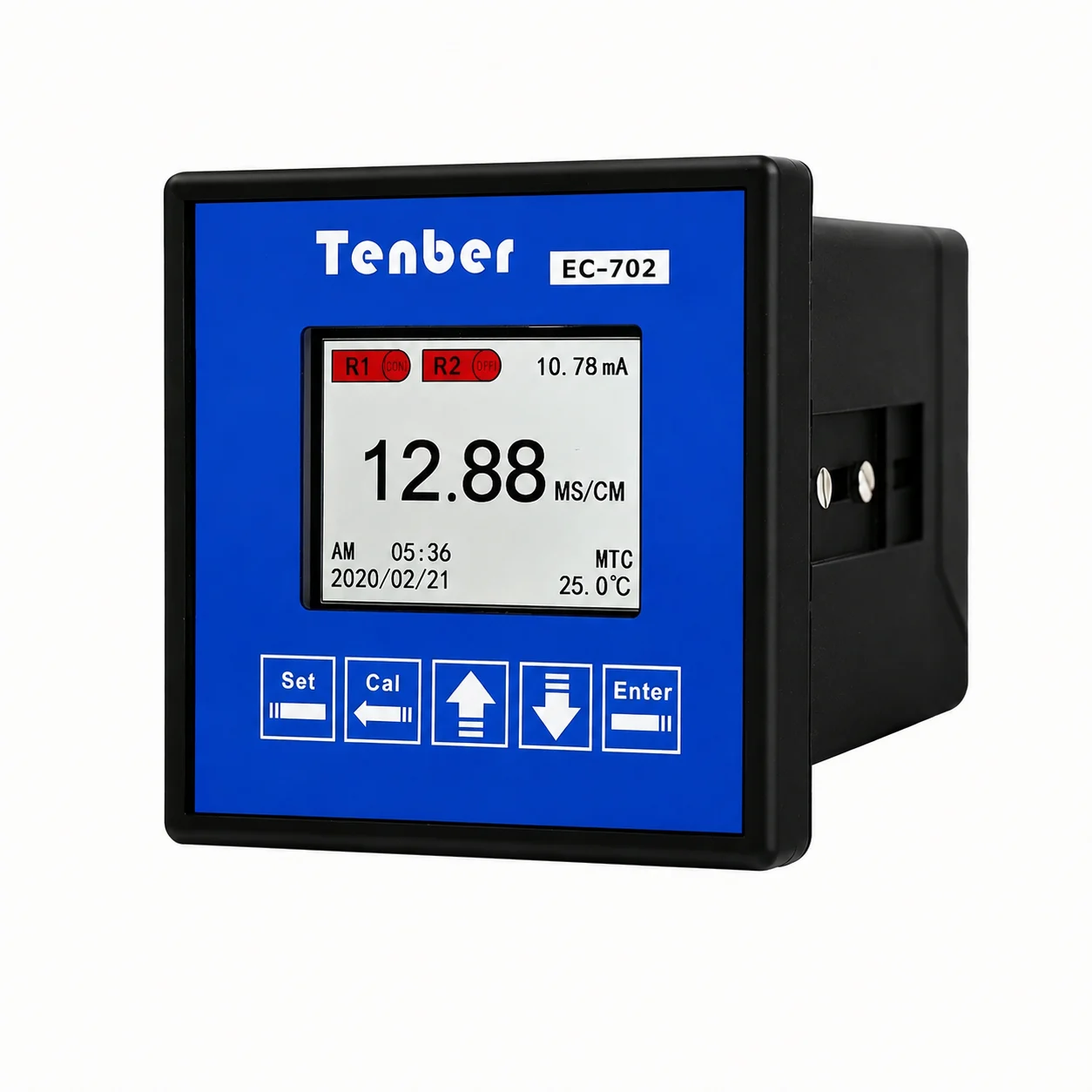
| EC-702 conductivity controller | Conductivity-related measurement, isolated 4–20 mA outputs and RS485 Modbus RTU are documented | A PLC/DCS project needs analogue output plus digital supervision | Exact variant, register map, temperature sensor, output range and relay scope |
| EC-703 conductivity controller | Current product material documents conductivity/TDS/resistivity measurement, analogue output and relay functions | A compact analogue-focused monitoring or alarm loop may fit | Current manual, sensor/cell constant, temperature input, output scaling and exact variant |
| ECS-7301 conductivity meter | Conductivity, resistivity, salinity and TDS measurement with two isolated current outputs and RS485 Modbus RTU are documented | A project needs more than one conductivity-related process value or digital integration | Measurement range, sensor type, output assignment, register map and local control needs |
Use the conductivity controller category to compare the current range. The table is a selection starting point, not a substitute for the current manual or approved project specification.
What should you check before choosing a conductivity controller?
Expected conductivity range and cell constant
Write down the minimum, normal, maximum and possible peak conductivity. Then match the sensor cell constant and controller setting to the actual liquid and installation. A cell suitable for RO permeate may not suit a concentrated process stream. Read the conductivity sensor cell-constant guide.
Temperature compensation
Conductivity changes with temperature. Confirm the temperature-probe type, wiring, compensation mode, reference temperature and the way the receiving system interprets the value. Do not compare a compensated online result with an uncompensated sample and call the difference a controller fault.
Sensor installation and process conditions
Check pipe diameter, flow, immersion depth, bubbles, deposits, cleaning access, pressure, temperature, chemical exposure and the possibility of air pockets. The sensor must be installed where the liquid is representative and the measurement remains repeatable.
Output and control requirements
Confirm whether the plant needs local display, isolated 4–20 mA, RS485 Modbus RTU, relay contacts, TDS, resistivity, salinity or another documented mode. For wiring and commissioning, see the industrial conductivity probe installation guide.
What is a conductivity controller suitable for?
- Continuous conductivity monitoring where the sensor, cell constant and temperature input match the stream.
- RO, process-water, cooling-water, boiler-water and selected concentration-monitoring projects.
- PLC, DCS, recorder, alarm and compatible blowdown or control arrangements with documented interfaces.
- Distributor, OEM and engineering enquiries that can provide the liquid, range, installation and signal requirements.
What is a conductivity controller not suitable for without further review?
- Choosing a sensor from a catalogue range without confirming cell constant and actual process conditions.
- Treating TDS, salinity, resistivity and conductivity as identical readings with interchangeable units.
- Assuming EC-702 and EC-703 have the same communication, relay or output functions.
- Setting an alarm or dosing action from a generic internet value instead of a verified site baseline and process specification.
- Using conductivity alone to identify a specific chemical or replace required laboratory analysis.
What should you confirm before requesting a quotation?
Send the liquid and application, minimum/normal/maximum conductivity, temperature and pressure, sensor or cell-constant requirement, installation method, cable length, temperature input, display unit, required 4–20 mA channels, RS485 or relay needs, quantity and destination country. Use Tenber’s conductivity controller quotation page for a configuration review.
Sources, author and update record
Sources: Current Tenber EC-702, EC-703 and ECS-7301 product documentation and public product pages; related Tenber RO, sensor cell-constant and installation guides.
Author: Tenber Technical Team.
Last updated: October 14, 2026.
Model functions, sensor compatibility, range and supplied variants must be confirmed against the current manual before ordering.