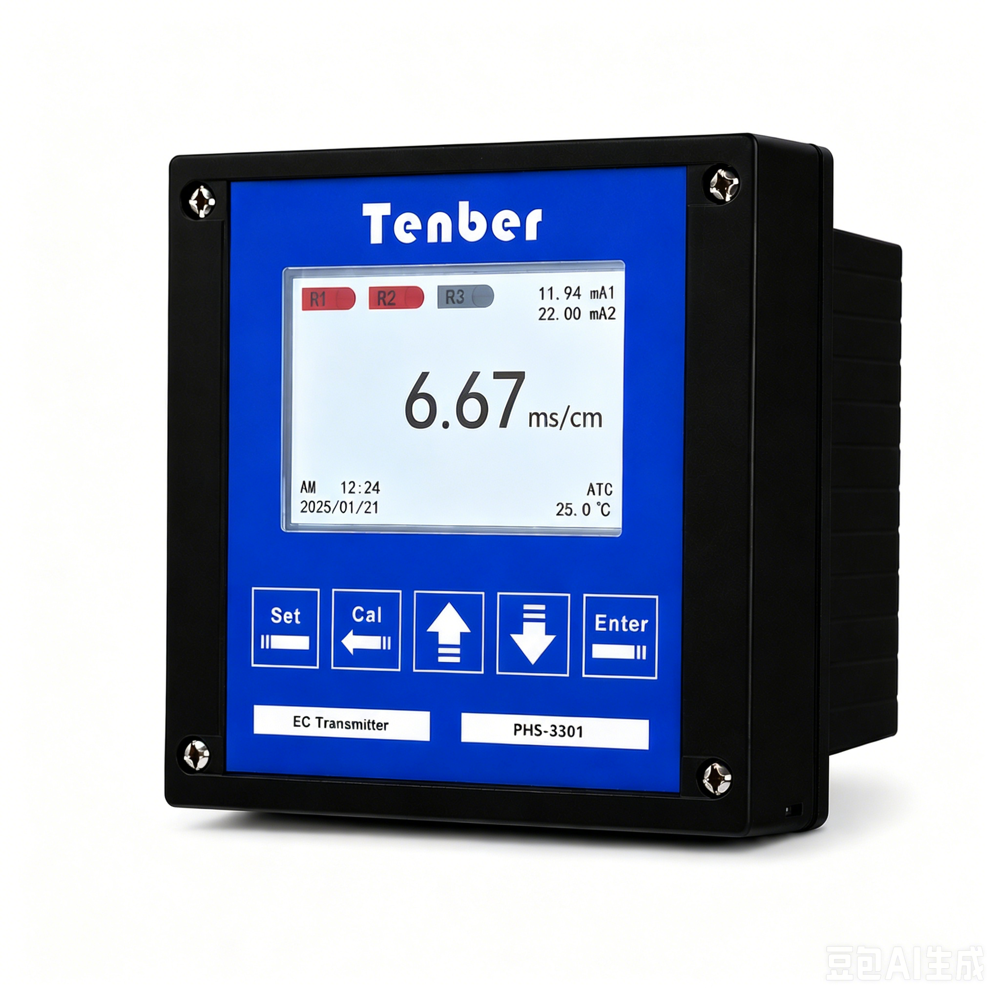
Built for continuous process monitoring
Industrial conductivity meter for EC, resistivity, salinity and TDS measurement with dual 4–20mA and RS485 Modbus RTU outputs.
Key specifications
| Function | EC / resistivity / salinity / TDS |
| Accuracy | ±1% F.S. |
| Output | Dual 4-20mA and RS485 Modbus RTU |
Need help confirming the right controller and sensor?
Not sure which controller and sensor fit your process? Send us the liquid, measuring range, temperature, installation method, required output and quantity. We will review the configuration before quotation.
Product Overview
Multi-mode conductivity monitoring for industrial water systems
Tenber ECS-7301 measures conductivity, resistivity, salinity and TDS for wastewater, environmental monitoring and process-water applications. Dual isolated 4–20mA outputs and RS485 Modbus RTU support integration with compatible automation systems.
Key Functions and Benefits
Key Benefits
Multiple Measurement Modes
One controller platform covers conductivity, resistivity, salinity and TDS monitoring requirements.
Automation Integration
Dual isolated 4–20mA and RS485 Modbus RTU outputs support compatible PLC and SCADA systems.
Sensor Matching Support
The sensor range and cell constant should be selected according to the expected conductivity and process conditions.
Verified Technical Specifications
Verified Technical Data
Typical Applications
Typical Applications
RO & Pure Water
Monitor conductivity or resistivity before and after membrane and purification stages.
Wastewater Treatment
Track changes in dissolved ionic content across treatment and discharge processes.
Electroplating Rinse Water
Conductivity monitoring can help follow rinse-water quality and process changes after the correct sensor range is confirmed.
Frequently Asked Questions
Frequently Asked Questions
Can ECS-7301 connect to a PLC or SCADA system?
Yes. The verified outputs include dual isolated 4–20mA and RS485 Modbus RTU. Confirm the required communication settings during model selection.
Can it measure pure water?
The controller supports resistivity measurement, but the correct sensor and measuring range must be confirmed for the expected water quality.
How do I choose the conductivity sensor?
Provide the expected minimum and maximum conductivity, liquid, temperature, pressure and installation method. These conditions determine the appropriate sensor range.
Can it be used in electroplating?
It can be considered for rinse-water and related conductivity monitoring. Confirm the chemical composition and measuring range before ordering.
What should be included in the inquiry?
Send the application, measuring range, medium, temperature, pressure, signal, installation method and quantity.
Manuals, Related Products and Request for Quotation
Need help confirming the right model?
Send the liquid, measuring range, temperature, pressure, installation method, output signal and quantity. Tenber will check the configuration before quotation.
Selection flow for ECS-7301
Start with conductivity-related measurement, then check the complete measuring loop before quotation.
- Define the application and liquid composition.
- Record the normal and maximum value, temperature, pressure and flow conditions.
- Choose the sensor or electrode, installation method, cable and maintenance access together with the controller.
- Confirm the receiving system, including 4–20mA, RS485 Modbus RTU, relay, recorder, PLC or DCS requirements.
- Send the quantity, destination country and current documentation requirement for model review.
Application boundaries
Confirm the measurement mode, cell constant, range, temperature compensation, outputs and installation for the supplied ECS-7301 configuration.
Inquiry checklist
Include the liquid, parameter and range, temperature, pressure, installation, sensor or electrode, cable length, output or communication interface, control requirement, quantity and destination country.