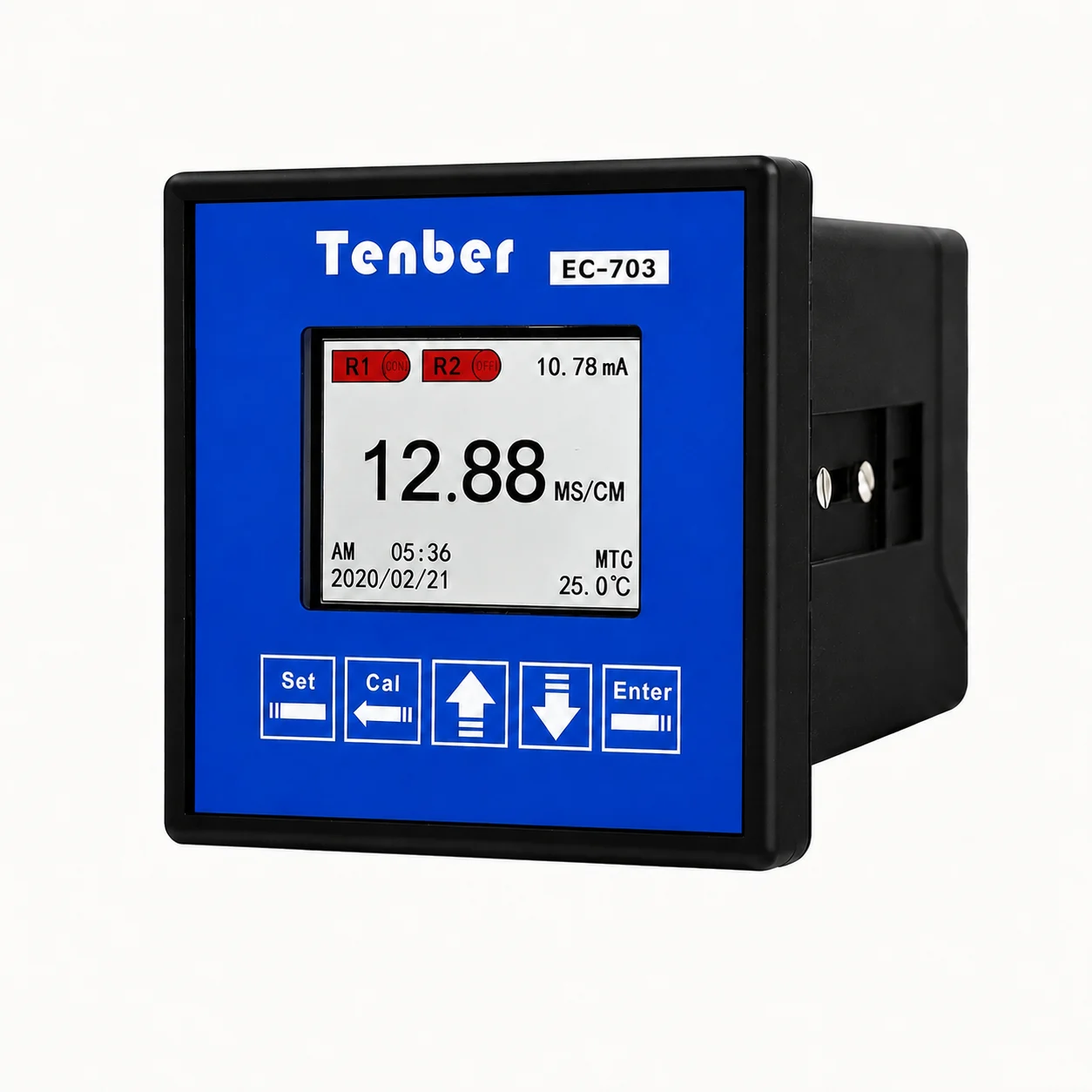
Built for continuous process monitoring
Industrial conductivity transmitter and controller for EC, TDS and resistivity measurement with isolated 4–20mA output, two relay outputs, Pt1000 or NTC30K temperature compensation, and IP65 front protection.
Key specifications
| Function | EC / TDS / resistivity |
| Temperature Range | -10 to +130°C |
| Output | Isolated 4–20mA and two relays |
Need help confirming the right controller and sensor?
Not sure which controller and sensor fit your process? Send us the liquid, measuring range, temperature, installation method, required output and quantity. We will review the configuration before quotation.
Product Overview
Compact conductivity transmitter and controller for industrial water systems
Tenber EC-703 is a compact conductivity transmitter and controller for continuous EC, TDS, resistivity and temperature monitoring. It is intended for projects that need a local display and an isolated 4–20mA signal without RS485 communication.
Select the controller together with the conductivity sensor, expected measurement range, temperature-compensation element and installation method. For applications that require RS485 Modbus RTU, review the EC-702 configuration instead. Both models are listed with two relay outputs.
Key Functions and Benefits
Key Features
Three measurement modes
Monitor conductivity, TDS or resistivity with one controller after the sensor and range have been selected for the process.
Analogue integration
An isolated 4–20mA output provides a practical connection to a compatible PLC, recorder or monitoring system.
Temperature compensation
Pt1000 and NTC30K temperature inputs are documented for automatic compensation across the specified temperature range.
Verified Technical Specifications
Verified Technical Specifications
Sensor, Range and Compatibility
Sensor and Range Selection
The controller range does not determine the complete measuring arrangement by itself. The conductivity sensor and cell constant must suit the minimum and maximum conductivity of the liquid. Water treatment, reverse-osmosis, process-water and chemical applications can require different sensor materials and installation arrangements.
Send the expected range, liquid composition, temperature, pressure and installation position before the sensor is selected. This avoids using a cell intended for low conductivity in a high-conductivity process, or the reverse.
For the complete conductivity cluster, compare the sensor and electrode range, review the RO conductivity monitoring guide, follow the industrial conductivity probe installation guide, and use the conductivity-to-TDS guide to define the displayed value and conversion basis. If RS485 Modbus RTU is required, review EC-702 before requesting a quotation.
Typical Applications
Typical Applications
Water Treatment
Track changes in ionic content across filtration, softening or treatment stages.
Reverse Osmosis
Use conductivity or resistivity as part of feed-water, permeate or concentrate monitoring after the range is confirmed.
Industrial Process Water
Send the analogue measurement to a compatible monitoring or control system.
Installation, Commissioning and Maintenance
Installation and Commissioning
- Confirm the panel cutout or wall/pipe mounting arrangement.
- Match the Pt1000 or NTC30K temperature input to the connected sensor.
- Set the measurement mode and range for EC, TDS or resistivity.
- Scale the isolated 4–20mA output to the receiving PLC or recorder input.
- Check the displayed value against a suitable conductivity reference before the signal is used for process decisions.
Install the sensor where the liquid is representative and the measuring surface remains properly wetted. Avoid dead zones, trapped air and locations that cannot be accessed for cleaning. Calibration and cleaning intervals should follow the actual fouling and drift observed at the site.
Model Selection and Inquiry Information
EC-703 or EC-702?
| Requirement | EC-703 | EC-702 |
|---|---|---|
| EC, TDS and resistivity measurement | Yes | Yes |
| Isolated 4–20mA output | Yes | Yes |
| RS485 Modbus RTU | No | Yes |
| Relay outputs | Two | Two |
Choose EC-703 when the receiving system only needs an analogue measurement signal. Choose EC-702 when the project requires RS485 Modbus RTU. Both models are listed with two relay outputs, while the published 5A/250VAC and 5A/30VDC contact rating is specifically marked for EC-702; confirm the required load before selecting EC-703. Confirm the receiving input, output scaling and wiring before ordering.
Frequently Asked Questions
Frequently Asked Questions
Does EC-703 include RS485 Modbus RTU?
No. RS485 Modbus RTU is documented for EC-702. EC-703 is the simpler choice for projects using an isolated 4–20mA signal.
Can EC-703 measure TDS and resistivity?
Yes. EC, TDS and resistivity are included in the documented measurement functions.
Which temperature sensor can be used?
The documented temperature-compensation inputs are Pt1000 and NTC30K.
What information is needed for selection?
Send the measurement range, liquid, temperature, pressure, installation method, sensor requirement, required output, quantity and destination country.
Compare the industrial conductivity controller range, review EC-702 with RS485 Modbus RTU, or discuss your EC-703 application.
Manuals, Related Products and Request for Quotation
Check the EC-703 measuring arrangement
Send the conductivity range, liquid, temperature, sensor and 4–20mA requirements. Tenber will review the controller and sensor combination before quotation.
From controller to complete measuring loop
Review the category, application conditions, selection guidance and compatible sensor before requesting a project quotation.
Related category
Application pages
Selection guides
Matching sensor
Project inquiry
Download the EC-703 English Technical Manual
Installation, wiring, settings, calibration and maintenance instructions for the EC-703 conductivity, resistivity and TDS controller.
Selection flow for EC-703
Start with conductivity-related measurement, then check the complete measuring loop before quotation.
- Define the application and liquid composition.
- Record the normal and maximum value, temperature, pressure and flow conditions.
- Choose the sensor or electrode, installation method, cable and maintenance access together with the controller.
- Confirm the receiving system, including 4–20mA, RS485 Modbus RTU, relay, recorder, PLC or DCS requirements.
- Send the quantity, destination country and current documentation requirement for model review.
Application boundaries
Confirm the current EC-703 range, output, sensor compatibility and installation from the current model documentation; do not substitute EC-701 specifications.
Inquiry checklist
Include the liquid, parameter and range, temperature, pressure, installation, sensor or electrode, cable length, output or communication interface, control requirement, quantity and destination country.