How conductivity is converted to TDS matters when you select an online conductivity meter. Conductivity is an electrical measurement. TDS is usually an estimate based on that measurement. Salinity uses a defined scale or salt concentration method.
Conductivity, TDS and salinity are not the same
Conductivity shows how easily water carries an electrical current. Dissolved ions affect the reading. Temperature also affects the reading. The instrument must therefore use suitable temperature compensation and a defined reference temperature.
TDS means total dissolved solids. A laboratory can measure TDS directly. An online TDS meter often estimates TDS from conductivity. Salinity describes salt content on a stated scale. It may use ppt, g/kg or a chemical-specific curve.
Use the correct name in a purchase specification. Do not use conductivity, TDS and salinity as interchangeable terms.
The basic conductivity-to-TDS formula
Estimated TDS = conductivity × configured conversion factor
The factor is not universal. Water with sodium chloride behaves differently from water with calcium, bicarbonate, silica or mixed industrial ions. The same conductivity value can therefore produce different estimated TDS values.
Before using the factor for control or reporting, define five items:
- Water chemistry and application.
- Conductivity unit and temperature reference.
- TDS unit, such as ppm or mg/L.
- Conversion factor or approved calculation method.
- Acceptable error compared with a reference test.
Compare online conductivity measurements with representative laboratory samples. Record the selected factor in the quotation and controller settings. A factor changes the estimate. It does not repair a faulty sensor or unstable installation.
RO water: feed, permeate and reject
A reverse osmosis system has several measurement points. Feed water, permeate, reject water and post-polishing water do not have the same conductivity range.
Conductivity or resistivity is usually the direct online indicator for RO performance. Permeate may have low conductivity. Reject water may have much higher conductivity. A sensor selected for permeate should not automatically be moved to the reject line.
Use the Tenber RO conductivity monitoring guide when defining the sample point: RO conductivity monitoring guide
TDS is useful when the customer specification requires ppm or mg/L. State whether the value is estimated from conductivity or measured by another method. Always state the conversion basis. Do not promise a TDS result without defining the method.
Cooling, boiler and condensate water
Conductivity can support blowdown, concentration or contamination monitoring. It does not identify the chemical source. Make-up water, condensate and boiler water can need different ranges and installation points.
Conductivity also does not replace hardness, alkalinity, chloride or corrosion testing. Define the exact control decision before choosing the instrument. Specify the normal and maximum conductivity, temperature, pressure, flow, sample conditioning and output.
Wastewater and brine
Wastewater conductivity can show an ionic change, mixing event or dosing problem. It cannot identify the contaminant by itself. If a permit requires TDS, confirm the accepted online or laboratory method.
For brine, specify the salt, concentration curve, temperature, wetted materials and upper range. High conductivity may need a different sensor from low-conductivity purified water. Fouling, scale, trapped air and poor flow can cause unstable readings.
How to select an industrial conductivity controller
Start with the process. Then select the controller and sensor as one loop. Record:
- Liquid, application and measurement point.
- Minimum, normal and maximum conductivity.
- Temperature, pressure, flow and chemical exposure.
- Conductivity, resistivity, TDS or salinity display.
- Sensor type, cell constant, materials and cable length.
- Temperature input and compensation reference.
- 4–20 mA, RS485 Modbus RTU, relay and PLC/DCS needs.
- Installation method, quantity and destination country.
Next, check the documented sensor range, units, calibration method, output scaling and communication map. A broad controller display range does not prove that the connected sensor is suitable.
Tenber controller options
EC-702 is a current option for projects that require documented conductivity-related modes, two isolated 4–20 mA outputs and RS485 Modbus RTU. Confirm the supplied configuration and current manual: EC-702 conductivity controller
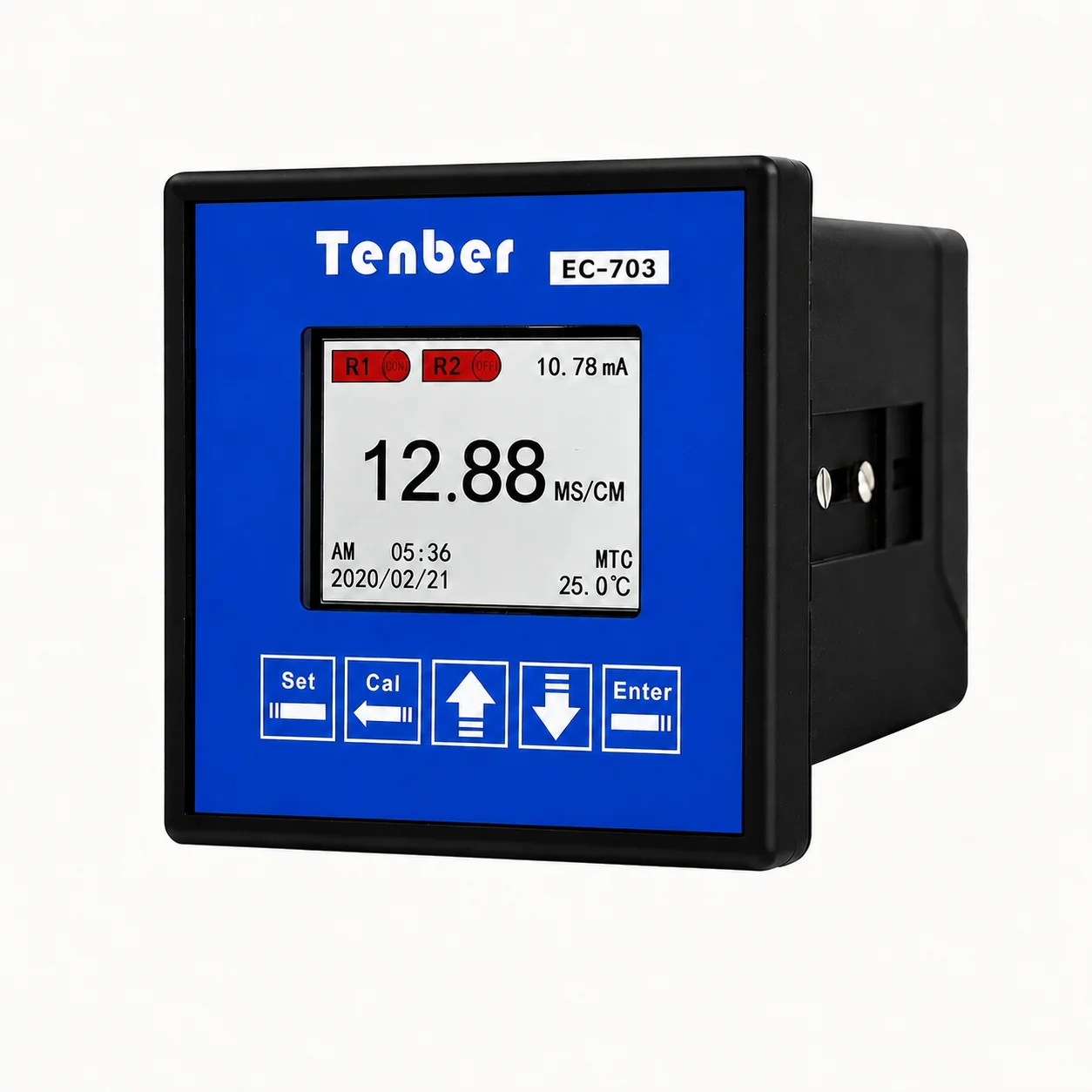
EC-703 is a current option with its own documented conductivity, resistivity, TDS and analogue configuration. Confirm the exact functions and sensor pairing: EC-703 conductivity controller
ECS-7301 is another current conductivity meter option. Confirm its range, sensor, outputs and application fit before selection: ECS-7301 conductivity meter
Calibration and verification
Use a standard solution suitable for the expected range. Confirm the temperature value, reference temperature, unit and decimal position. If the instrument reports TDS, record the conversion factor or method.
Compare the online value with a suitable reference at the same sample point. If the result is unstable, inspect coating, trapped air, poor flow, cable damage, temperature compensation, grounding and sensor placement. Do not change the cell constant or TDS factor without evidence.
Quick answers
Is conductivity the same as TDS? No. Conductivity is electrical. TDS is measured or estimated dissolved solids.
Which value is best for RO? Conductivity or resistivity is usually the direct online measurement. Use TDS when ppm or mg/L is required and the factor is verified.
Is salinity interchangeable with TDS? No. Use the defined scale and method for the liquid.
Can one meter cover feed, permeate and reject? Do not assume so. Range, cell constant, temperature, materials and installation may differ.
The practical rule is simple. Define the liquid and measurement decision first. Then verify the conversion method and select the conductivity controller and sensor as a documented loop.
Assigned topic: Conductivity-to-TDS measurement logic. See feed, permeate and reject conductivity logic.