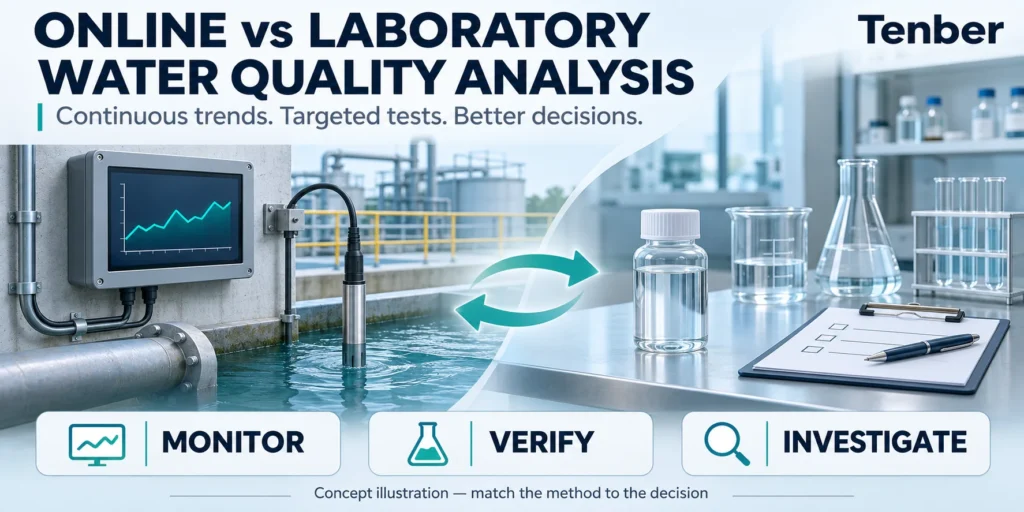
Online vs laboratory water quality analysis is a choice about the decision you need to make. Online instruments follow selected parameters at the process point and can support alarms or control. Laboratory analysis tests collected samples using methods suited to the requested analytes. Many plants need both: continuous trends to notice change and targeted tests to investigate it.
Neither approach is automatically more accurate. The result depends on the method, sampling, calibration and quality checks. Start with the required parameter and response time before choosing equipment.
Online vs Laboratory Water Quality Analysis: What Is the Difference?
The main difference is how the measurement fits into the workflow. An online instrument measures water in the process or a connected sample stream and updates the result at a defined interval. Laboratory analysis uses a collected sample and a specified test procedure. It can cover substances beyond the installed sensors, but the result refers to that sample and its collection conditions.
Online does not always mean an instant result. Sample transport, sensor response, measurement cycles and signal filtering can introduce delay. Laboratory turnaround also varies with the test, transport and workload. Specify the useful response time rather than relying on either label.
| Decision factor | Online water quality monitoring | Laboratory water analysis |
|---|---|---|
| Main role | Follow selected process variables and detect changes | Test requested analytes in collected samples |
| Time coverage | Repeated measurements during operation | A sample or sampling period defined by the plan |
| Operational action | Can feed alarms or control when configured | Supports review and investigation after testing |
| Parameter coverage | Limited to the installed instruments and methods | Depends on the laboratory's available methods |
| Main quality risks | Fouling, drift, installation and unrepresentative flow | Collection, preservation, transport and method handling |
| Ongoing work | Cleaning, calibration, inspection and replacement | Sampling, records, transport and analytical quality checks |
| Best comparison basis | The complete installed measurement loop | The full sampling and analytical procedure |
The table describes typical roles. It does not establish that a particular instrument or laboratory meets a project's acceptance requirements.
When is online water quality monitoring the better fit?
Choose online monitoring when a change matters before the next scheduled sample can be tested. Examples include pH during chemical dosing, conductivity in RO permeate, dissolved oxygen during aeration and turbidity around filtration. The parameter and measuring point must match the actual process decision.
An online trend can show when a disturbance began, how long it lasted and whether the process recovered. A single sample cannot reconstruct every change between collection times. A continuous record still needs valid data: a fouled sensor can produce a long and convincing trend that is wrong.
The U.S. EPA's guidance on protecting distribution-system water quality with online monitoring describes using online analyzers to detect changes and inform operations. That supports a clear distinction between operational visibility and the separate sampling requirements of a monitoring program.
For the hardware boundary, see the online water quality monitoring system components guide. Confirm the sensor, controller, installation and signal path together.
When is laboratory water analysis still needed?
Use a laboratory when the question requires a test that the installed system cannot perform. A pH probe does not identify which chemical entered the water. Conductivity indicates electrical response from dissolved ions; it does not name every ion. Turbidity alone does not identify a contaminant.
Laboratory work can help identify a suspected substance, investigate a process upset or provide a result under a required method. Define the analyte, reporting limit and sample requirements before ordering the test. A general request for a complete water test can leave the important question unanswered.
For project acceptance or regulated reporting, confirm the applicable method, sampling plan and documentation with the responsible organization. An online instrument is not automatically an accepted substitute for a laboratory test. A laboratory result is also not automatically the right check for every fast-changing field parameter.
Why can an online reading differ from a laboratory result?
First ask whether the two results represent the same water, time, parameter and measurement basis. A sample collected upstream during one operating condition is not a direct check of a downstream sensor after dosing changes. Compare locations and timestamps before adjusting either instrument.
Water can change after collection. Temperature, gas exchange, biological activity and settling may affect a result. The USGS guidance on collecting and processing stream-water samples explains why several field measurements can change within minutes or hours after collection. Follow the procedure for the specific parameter rather than applying one handling rule to every test.
| Before comparing results | Why it matters | Useful record |
|---|---|---|
| Same parameter and units | Similar labels may refer to different quantities | Analyte, unit and method |
| Same location and time | Treatment and flow can change the water | Collection point and timestamps |
| Sample handling | Storage or preparation can alter the property | Container, handling and elapsed time |
| Temperature basis | Actual and reference-temperature values can differ | Sample temperature and compensation setting |
| Instrument condition | Deposits or expired standards can affect checks | Calibration, inspection and cleaning records |
| Method suitability | Two valid methods may have different limits | Range, reporting limit and acceptance criteria |
Do not average conflicting results to make the disagreement disappear. Identify the reason and document which result is fit for the decision. For the pH-specific comparison procedure, use the existing guide to online versus laboratory pH readings.
How can online monitoring and laboratory testing work together?
Build a plan around triggers and responsibilities. Decide which online changes prompt a sample, who collects it and what the laboratory should test. Preserve the trend around the collection time so the analytical result can be interpreted in context.
Consider a hypothetical conductivity rise in RO permeate. The online signal identifies the timing. An operator checks the sensor, temperature basis and process conditions. If the change is real or unexplained, targeted sampling can help investigate its cause. This is an example workflow, not a Tenber customer case or a guarantee that one test will find the cause.
- Define the operational variable and a suitable measuring location.
- Establish calibration checks and maintenance records.
- Agree on alert thresholds and the response procedure.
- Collect a targeted sample when the plan calls for one.
- Record collection time, online value and process state.
- Review the laboratory result alongside the trend and method limits.
An alarm is a prompt to follow the response plan. It does not identify every cause by itself. The water quality sensor calibration guide covers the instrument checks to include.
Which online instruments should a plant specify?
Begin with the process variable. For pH or ORP, review the Tenber PH-303 pH and ORP controller with an electrode suited to the liquid. For conductivity, review the Tenber EC-703 conductivity controller with the required cell, range and temperature input.
These are starting points for a configuration review. They do not turn a single-parameter loop into a general laboratory analyzer. Confirm sensor compatibility, process limits, mounting and required signals against the current model documentation.
If remote access is needed, define the complete data path. A display or communication port alone does not establish cloud access. Use the online water quality data logging guide to separate instrument outputs from logging, network and software requirements.
How should the costs of the two approaches be compared?
Compare the required coverage rather than one instrument against one sample fee. An online budget includes installation, maintenance, calibration and replacement parts. A laboratory budget includes collection work, containers, transport, tests and reporting. The frequency and purpose of each task determine the useful comparison.
Do not assume that buying an online sensor removes all laboratory spending. It may provide a process signal while targeted tests continue. The online water quality analyzer cost guide provides a scope table for the installed equipment side of that budget.
What should be included in a monitoring inquiry?
Tell Tenber what the plant needs to display, alarm, record or control. Include the liquid, parameter, normal and extreme range, temperature, pressure and installation point. Add the required outputs and any laboratory method used for comparison.
For projects in Vietnam, Indonesia, Malaysia or the United States, include the destination and site documentation requirements. A country name alone does not define the method or acceptance criteria. Share the actual project specification where available.
Then request a monitoring configuration review. A sample-point sketch and existing instrument labels help distinguish an equipment need from a sampling or method problem.
Frequently asked questions
Is online water analysis more accurate than laboratory testing?
Neither label proves accuracy. Compare the measurement method, sampling conditions, calibration and quality controls. Online monitoring provides time coverage; a laboratory test provides information under its defined analytical procedure.
Can an online analyzer replace the laboratory?
It can perform selected measurements continuously, but it does not replace every analytical method. Confirm which parameters and reporting requirements remain outside the installed system.
Is a grab sample the same as a laboratory test?
No. A grab sample is a collection at a particular place and time. It can be tested promptly in the field or sent for laboratory analysis, depending on the parameter and procedure.
How often should laboratory samples be taken?
Use the monitoring objective, process risk and applicable sampling plan to set the frequency. There is no universal interval that fits every plant, analyte and reporting purpose.
Where do water testing kits and contaminant tests fit?
Water utilities and water treatment plants may use field kits for selected checks. Water testing kits do not replace every laboratory method. For a public water system or an industrial water supply, define the required test and its quality checks before selecting a kit.
If the question concerns specific contaminants such as volatile organic compounds, ask the laboratory to confirm a suitable method and sample handling. A change in an online trend can trigger that investigation; it cannot identify all water contaminants.
Conductivity can support an estimate of total dissolved solids when a suitable conversion is defined. It is not a direct test for each dissolved substance. If the water source changes, review the conversion basis instead of treating the same factor as universal.
Sources and scope
Prepared by the Tenber Technical Team. Updated November 6, 2026. This is an original equipment-selection and monitoring-workflow guide. Linked EPA and USGS references explain monitoring roles and sample handling. They do not certify Tenber products. Confirm the current model manual and project-specific analytical requirements before commissioning.