Quick answer: A pH controller measures the acidity or alkalinity of a liquid through a connected pH electrode, displays the value, and can send a process signal or control output when the selected model supports it. In water treatment, it helps operators monitor neutralization, dosing and process changes continuously.
How does an industrial pH controller work?
An industrial pH controller is one part of a complete measurement system:
- The pH electrode responds to the liquid’s hydrogen-ion activity.
- The controller receives the electrode signal and, where supported, a temperature input.
- The instrument applies the selected measurement and compensation settings.
- The display shows the process value and status information.
- Analogue outputs, RS485 Modbus RTU or relays pass information to a PLC, DCS, recorder, alarm or compatible dosing arrangement.
The controller cannot correct a coated glass bulb, blocked reference junction, trapped air pocket, poor grounding or a sensor installed at a non-representative point. A stable result depends on the complete loop, not only the electronics.
Where is a pH controller used?
Wastewater neutralization
In wastewater treatment, online pH measurement can help an operator see whether an equalization or neutralization stage is moving toward its process target. The control strategy still depends on mixing, chemical transport, tank volume, dosing equipment and site safety limits.
Chemical dosing and process water
A pH controller may provide a measurement signal for acid or alkali dosing, chemical-process monitoring or an alarm. The sensor must match the liquid chemistry, temperature, pressure, solids, cleaning plan and installation method.
PLC and DCS integration
A PLC with spare analogue inputs may use 4–20 mA. A digital supervision system may require RS485 Modbus RTU. A local dosing or alarm design may require relay functions. Confirm the exact channel assignment, isolation, register map and receiving input before wiring.
What is the difference between a pH meter, pH transmitter and pH controller?
The terms overlap in supplier catalogues, so define the required function rather than choosing by name alone.
| Term | Main role | Questions to confirm |
|---|---|---|
| pH meter | Measures and displays pH, often for checking or monitoring | Is it designed for continuous industrial installation? |
| pH transmitter | Sends a measurement to another system | Which signal, channel, isolation and scaling are required? |
| pH controller | Measures, displays and may provide outputs, communication or relay control | Is local control required, and does the exact model support it? |
Which Tenber pH controller should you review?
| Current model | Documented integration direction | When it may fit | Verify before ordering |
|---|---|---|---|
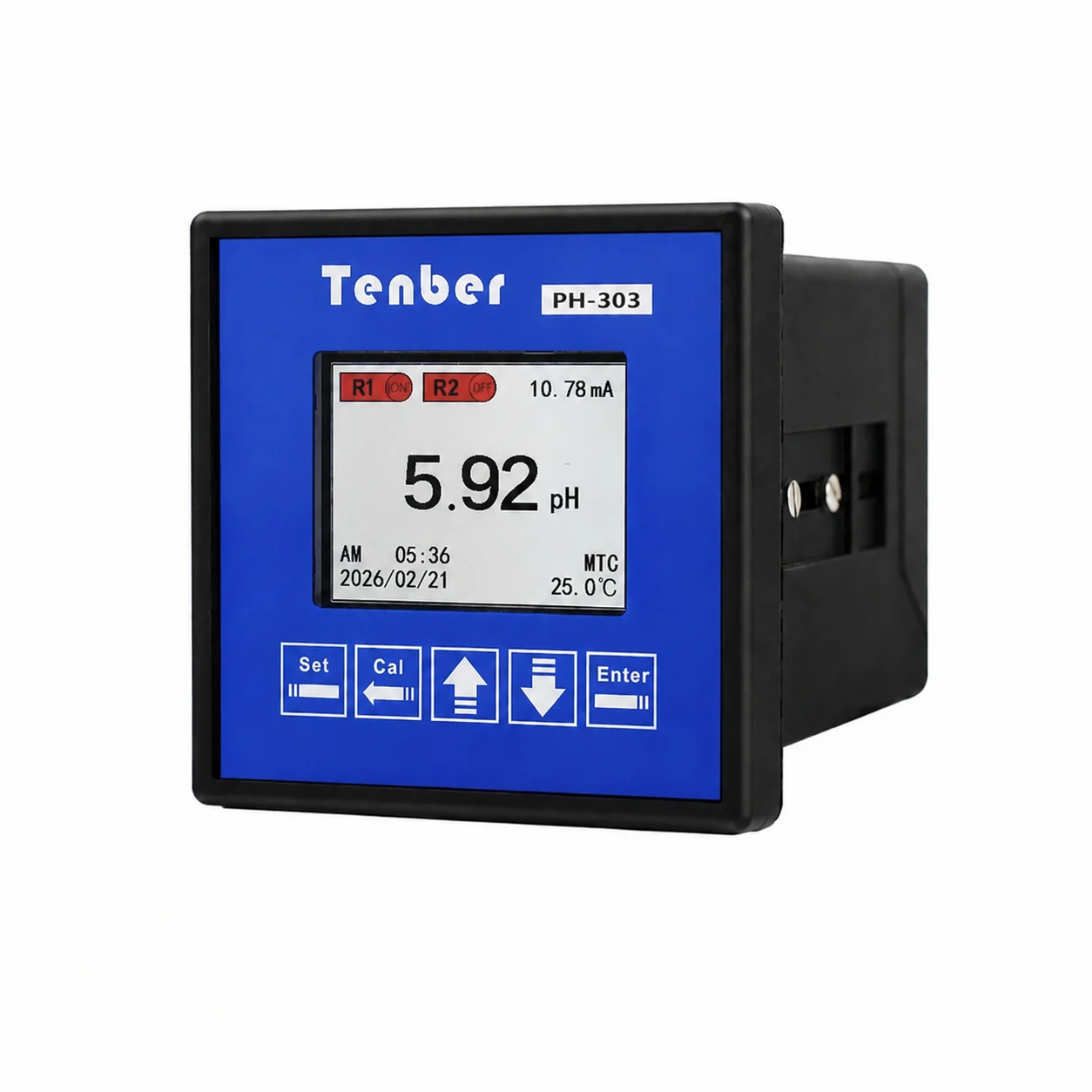
| PH-303 pH/ORP controller | one isolated 4–20 mA output (500 Ω max; ±0.05 mA accuracy) are documented | Analogue one pH or ORP signal; temperature input is for compensation are required | Output mapping, sensor input, temperature element and exact variant |
| PH-302 pH/ORP controller | One isolated 4–20 mA output, RS485 Modbus RTU and two relay outputs are documented | A PLC/DCS or dosing project needs analogue, digital and relay functions | Register map, relay rating, wiring, electrode and control logic |
| PHS-3301 pH/ORP controller | Isolated current outputs plus RS485 Modbus RTU and broader control functions are documented | More than one process value or digital integration is needed | Output assignment, register map, logging and supplied configuration |
These are selection starting points, not a substitute for the current model manual or approved project specification. Review the complete pH/ORP controller category before making a model decision.
What should you check before choosing a pH controller?
Process conditions
Record the liquid, normal and peak pH, temperature, pressure, solids, oil, biological fouling, chemical exposure, flow and installation point. Include whether the electrode will be mounted in a tank, pipe, bypass or flow cell.
Electrode and temperature compatibility
Choose the electrode for the chemistry and maintenance conditions, not only for a nominal pH range. Confirm the reference system, body material, connector, cable length, temperature element and mounting. See the industrial wastewater pH electrode selection guide.
Output and control requirements
Write down what the PLC, DCS, recorder, alarm or dosing panel must receive. Confirm whether the project needs pH, ORP, temperature, 4–20 mA, RS485 Modbus RTU, relay contacts or a local display. Review the pH controller wiring guide.
What is a pH controller suitable for?
- Continuous pH or ORP monitoring where the selected electrode and controller match the process.
- Wastewater neutralization, chemical dosing supervision and industrial process-water monitoring.
- Projects that need a documented analogue, digital or relay interface on the selected model.
- Distributor, OEM and engineering enquiries where the liquid and integration requirements can be shared.
What is a pH controller not suitable for without further review?
- Selecting a sensor only from the pH number while ignoring chemistry, temperature, fouling or mounting.
- Assuming every model has the same relay, Modbus, output or data-logging functions.
- Enabling automatic dosing from an unverified or unstable measurement.
- Making a certification, accuracy, service-life or compatibility claim without the current model documentation.
What should you confirm before requesting a quotation?
Send the liquid and treatment stage, normal and peak pH, temperature, pressure, solids or oil, installation method, electrode and cable requirement, temperature element, required 4–20 mA channels, RS485 or relay needs, quantity and destination country. Use Tenber’s pH controller quotation page to request a configuration review.
Sources, author and update record
Sources: Current Tenber PH-302, PH-303 and PHS-3301 product documentation and public product pages; related Tenber pH electrode and wiring guides.
Author: Tenber Technical Team.
Last updated: October 14, 2026.
Model functions, sensor compatibility and supplied variants must be confirmed against the current manual before ordering.