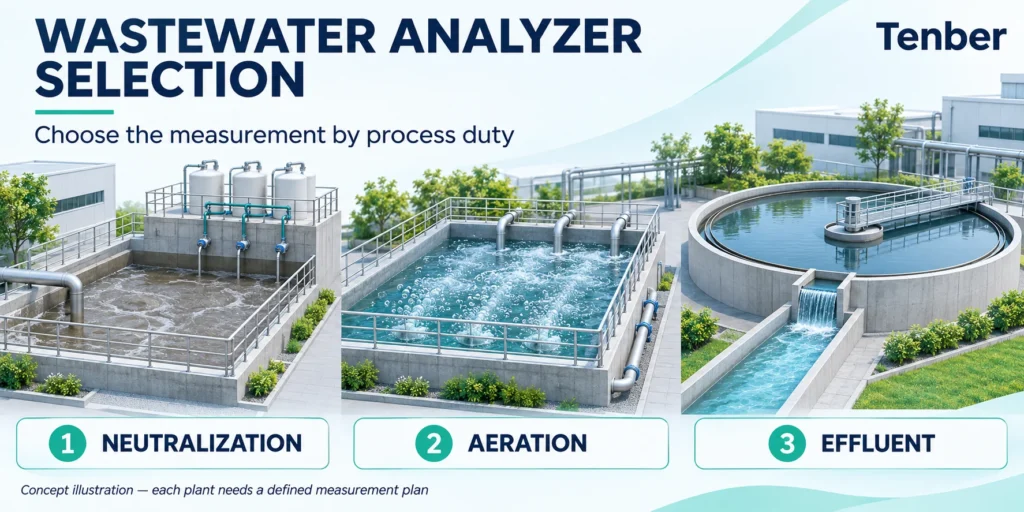
Choose an online water quality analyzer for wastewater treatment by the job it must do. Start with the process point and the action needed from the reading. Then match the sensor, range, mounting and plant signal. A wastewater monitoring system may need several loops; one display does not mean every pollutant is measured.
Continuous monitoring can reveal changes between grab samples. It still needs a sound measuring point and routine checks. More readings cannot fix a probe that sits in the wrong place.
How do you choose an online water quality analyzer for wastewater treatment?
Write down what the reading should make someone do. Will it warn an operator, guide dosing, support aeration control or create a trend? Choose the parameter from that task, then review the water at the exact point of use.
For example, a pH signal from a mixed tank is a clear duty. “A wastewater analyzer” leaves the parameter, sensor and scope open. This is the first step in wastewater analyzer selection.
Which measurement fits each treatment stage?
Use this matrix as a starting point. It is not a required instrument list for every wastewater treatment plant.
| Process point or duty | Measurement to review | Useful process question | Main risk to check |
|---|---|---|---|
| Inlet or equalization tank | pH or conductivity where relevant | Has the incoming water changed? | Poor mixing, deposits and peak values |
| Acid–alkali dosing | pH | Is the mixed water within the process band? | Wrong electrode or location |
| Oxidation or reduction step | ORP where suitable | Is the redox trend useful for this process? | Unproven link to the control task |
| Aeration basin | Dissolved oxygen | What are the oxygen conditions in this zone? | Fouling and a poor measuring point |
| Clarifier, filter or final effluent | Turbidity where suitable | Has optical clarity or particle carryover changed? | Bubbles, colour, deposits and range |
| Named pollutant or nutrient | A suitable analyte-specific method | What is the level of that substance? | Method limits and sample handling |
The EPA Water Sensors Toolbox lists common water quality parameters. It also discusses placement, fouling and upkeep. Those issues matter before choosing a model.
What matters most for a wastewater pH loop?
Check the liquid before choosing the electrode. Record solids, oil, scale, fluoride and cleaning chemicals where present. State normal temperature and pressure as well as brief extremes.
Place the probe where the liquid represents the control task. Avoid a local pocket beside a dosing point. Follow the industrial pH sensor installation guide for the mounting review.
Review the Tenber PH-303 pH and ORP controller with a suitable electrode. Confirm the input, temperature element and outputs in the current manual. The controller cannot protect the wrong electrode from chemical attack.
How should DO and turbidity duties be defined?
For dissolved oxygen, state the basin zone and the intended action. Use the process design to set targets. Do not copy a number from another plant. Check how staff will remove and clean the probe. The DO controller selection guide for aeration covers that loop in more detail.
For turbidity, give the normal value and the largest event that must be detected. Water in a solids-rich process stage differs from final effluent. Read the wastewater turbidity sensor selection guide for range and optical checks.
Turbidity does not directly establish every suspended-solids, COD or BOD value. Ask for the actual quantity needed and a suitable method. A trend is useful, but it should not be given a meaning the method cannot support.
Should the sensor sit in the tank or in a bypass?
Choose from the duty and service needs. Direct immersion avoids a sample line but needs a safe holder and removal access. A bypass can ease service, yet adds a sample path that may clog or delay the reading.
| Check before ordering | Why it matters | Useful inquiry detail |
|---|---|---|
| Mixing at the sensing point | A local pocket may not represent the process | Sketch and nearby dosing points |
| Cleaning and removal | A probe must be easy to service | Holder, access and isolation plan |
| Solids, oil and deposits | Coatings can affect the response | Liquid details and fouling history |
| Sample flow and delay | A bypass may lag the process | Line length, flow and conditioning |
| Response to a fault | Bad data must not look like a process change | Alarm, hold and operator action |
Do not add a filter by default. Removing particles would change a sample used for a particle-related test. Define any sample treatment and its effect on the result.
What should connect to the PLC or SCADA system?
Specify each value, unit and signal needed. State the number of analog channels and relay actions. An RS485 port also needs the correct protocol and register map.
For conductivity, review the Tenber EC-703 conductivity controller with the cell, range and temperature input. Conductivity can track changes in ionic content. It does not identify every dissolved chemical.
Real time data is only useful if the whole data path works. A port alone does not provide remote access. Identify the logger, gateway, network and software where needed.
What should be tested at startup?
Check the complete wastewater monitoring system before using its signal for control. Inspect the sensor and mounting. Check units, calibration and temperature input. Then verify the value and fault states received by the plant.
Use the water quality system commissioning checklist to record the loop tests. Assign cleaning and verification tasks. Do not change a process setting just to hide an unexplained reading error.
What makes a useful wastewater analyzer quotation?
Ask for the controller, sensor, holder, cable and sample assembly as separate items. State what the site will supply. Add startup work, spares and routine service to the budget. The online analyzer cost guide helps compare the same scope across offers.
For a review, send the wastewater source, treatment stage, parameter, range and liquid conditions. Add a mounting sketch, required outputs, quantity and destination. Include the site's acceptance criteria for projects in Vietnam, Indonesia, Malaysia or the United States.
Then request a wastewater analyzer configuration review. Explain what the reading must make the operator or control system do. That gives Tenber a clearer basis for a matched loop and itemized quote.
Frequently asked questions
Can one analyzer measure all wastewater parameters?
Not automatically. Each parameter needs a suitable sensor or analytical method. Check what the quoted package actually includes.
Can pH and turbidity prove full discharge compliance?
No. They measure specific properties. Confirm the required sampling, analytical methods and records with the responsible project team.
How often should a wastewater sensor be cleaned?
Use the model instructions and site evidence. Inspect for fouling and keep records. A service interval from cleaner water may not suit industrial wastewater.
Sources and scope
Prepared by the Tenber Technical Team. Updated November 7, 2026. This original selection guide links to EPA resources and relevant Tenber guides.
Confirm the current manual, process design and written configuration before ordering. No universal setpoints or removal guarantees are provided.