Need help choosing an industrial pH meter?
Tell us your water application, measuring range and output requirement. We will recommend a suitable model.
Choosing an industrial pH meter is a complete measuring-loop decision, not only a choice of display range. Confirm the liquid, expected pH or ORP range, temperature, pressure, electrode, installation point, output signal and control requirement together. Send your water application, measuring range and output requirement and Tenber will recommend a suitable model.
Need help choosing an industrial pH meter?
Tell us the liquid, range, temperature, installation and signal requirement before you order the controller and electrode.
1. Define the process before comparing models
Start with the process conditions that can change the electrode response or the useful life of the measuring loop. Record the liquid composition, expected pH or ORP range, temperature, pressure, suspended solids, oil, cleaning chemicals and the location where the reading must represent the process.
| Selection question | Why it matters | Information to send |
|---|---|---|
| What liquid is measured? | Chemistry, deposits and fouling affect the electrode and reference junction. | Wastewater type, acids, alkalis, salts, oil, solids and cleaning exposure. |
| What range and temperature are expected? | The controller range does not prove that one electrode is suitable for every condition. | Normal, minimum and maximum pH or ORP, temperature and pressure. |
| Where will the sensor be installed? | A representative and serviceable position is needed for stable readings and maintenance. | Tank, pipe, bypass, flow cell, immersion depth, cable length and access. |
| How must the value reach the control system? | Channel count and interface determine the controller shortlist. | 4–20mA, RS485 Modbus RTU, relay, recorder, PLC or DCS requirements. |
2. Choose the industrial pH electrode with the controller
The controller and electrode should be treated as one configuration. A nominal pH range is not enough to select the wetted materials, reference arrangement, temperature input, connector or mounting. Provide the liquid and installation conditions before selecting a pH sensor or electrode.
Questions for wastewater and process liquids
- Will suspended solids, sludge, oil or treatment chemicals coat the sensing surface?
- Will the electrode remain immersed and accessible for cleaning and calibration?
- Is automatic temperature compensation required, and which temperature input is available?
- Does the sample point have stable flow and representative mixing?
3. Match the controller to the plant signal
Use 4–20mA when the receiving PLC, DCS, recorder or monitoring input requires an analogue signal. Consider RS485 Modbus RTU when the project needs a documented digital interface. Relay functions are a separate requirement and must be confirmed on the exact model. Do not infer channel count, isolation, relay logic or register mapping from the product family name.
pH controller comparison for the measuring loop
| Model | Documented integration | When to consider it | Confirm before ordering |
|---|---|---|---|
| PH-303 | Two isolated 4–20mA outputs | Two analogue channels are required without currently documented RS485 or relay functions. | Electrode, temperature input, mapping, mounting and power. |
| PH-302 | One isolated 4–20mA output, RS485 Modbus RTU and two relay controls | The panel needs analogue, digital communication and relay control. | Output scaling, Modbus settings, relay logic and electrode. |
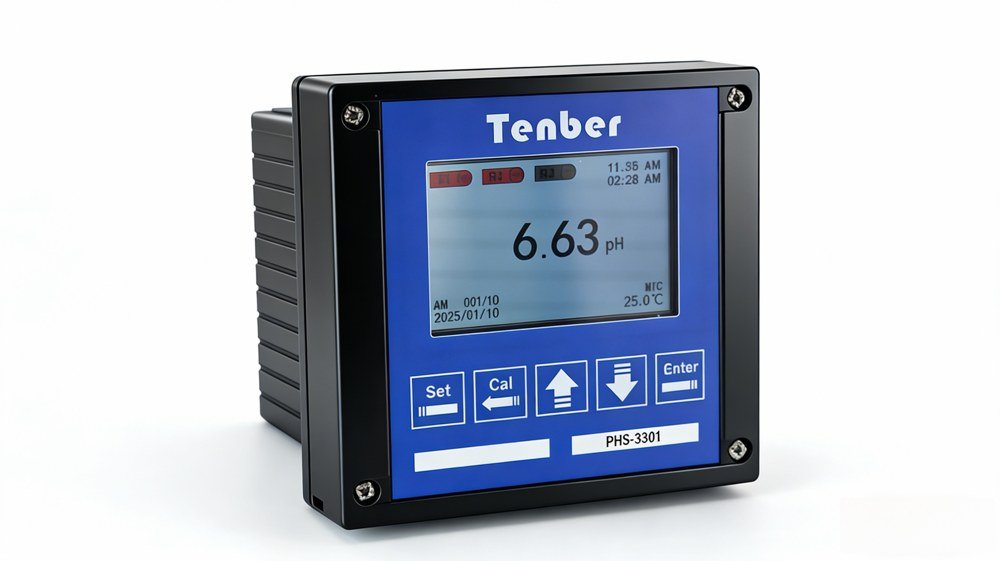
| PHS-3301 | Two isolated 4–20mA outputs, RS485 Modbus RTU and broader documented functions | The project needs broader integration or documented record functions. | Panel opening, records, sensor input and relay functions. |
Current Tenber model routes
Current Tenber Models at a Glance
PH-303, EC-702 and EC-703 are current product routes for different measurement parameters. They are not interchangeable. Use this overview to reach the relevant product page, then confirm the complete controller-and-sensor configuration before ordering.
| Model | Main measurement | Documented integration direction | When to shortlist | Confirm before ordering |
|---|---|---|---|---|
| PH-303 | pH / ORP / temperature | Two isolated 4–20mA outputs | Two analogue channels are required and the selected project does not require documented RS485 or relay functions. | Electrode, temperature input, output mapping, mounting and power. |
| EC-702 | Conductivity-related measurement, including documented conductivity, resistivity, salinity and TDS functions | Dual isolated 4–20mA and RS485 Modbus RTU | The conductivity loop needs analogue signals and digital communication for a compatible PLC, DCS or monitoring system. | Normal and peak range, cell constant, sensor, temperature, pressure and installation. |
| EC-703 | Conductivity-related measurement | Analogue-focused route; exact current variant and output scope must be confirmed | A simpler conductivity monitoring loop may fit when the required analogue interface is confirmed. | Current manual, exact range, outputs, sensor compatibility, mounting and communication requirement. |
Selection rule: choose the measurement parameter first, then match the sensor, range, temperature, installation and control-system interface. If the project needs a written recommendation, request model selection.
What to include in a quotation request
Send the application, liquid, parameter and range, temperature, pressure, installation method, cable requirement, output or communication interface, control requirement, quantity and destination country. Tenber will review the complete configuration before quotation.
Tell us your water application, measuring range and output requirement.
We will recommend a suitable model and identify the technical details that still need confirmation.
Frequently Asked Questions
Can I choose the controller from the measurement range alone?
No. The liquid, sensor, temperature, pressure, installation, output and maintenance conditions must be checked as one measuring loop.
Are PH-303, EC-702 and EC-703 interchangeable?
No. PH-303 is a pH/ORP route, while EC-702 and EC-703 are conductivity-related routes. Choose the parameter first, then confirm the complete model and sensor configuration.
What information should I send for model selection?
Send the application, liquid, range, temperature, pressure, installation, output or communication requirement, quantity and destination country.
Technical references
Use these primary references to validate measurement concepts, process context and communication requirements. They do not replace the current Tenber manual or project-specific compatibility review.
Start with the receiving system: confirm the PLC or DCS input, required analogue channels, Modbus communication, relay logic and the pH or ORP electrode connection. Tenber can then compare PH-303, PH-302 and PHS-3301 against the actual panel requirement.
Request a pH controller and electrode review or read the 4–20 mA vs RS485 integration guide.