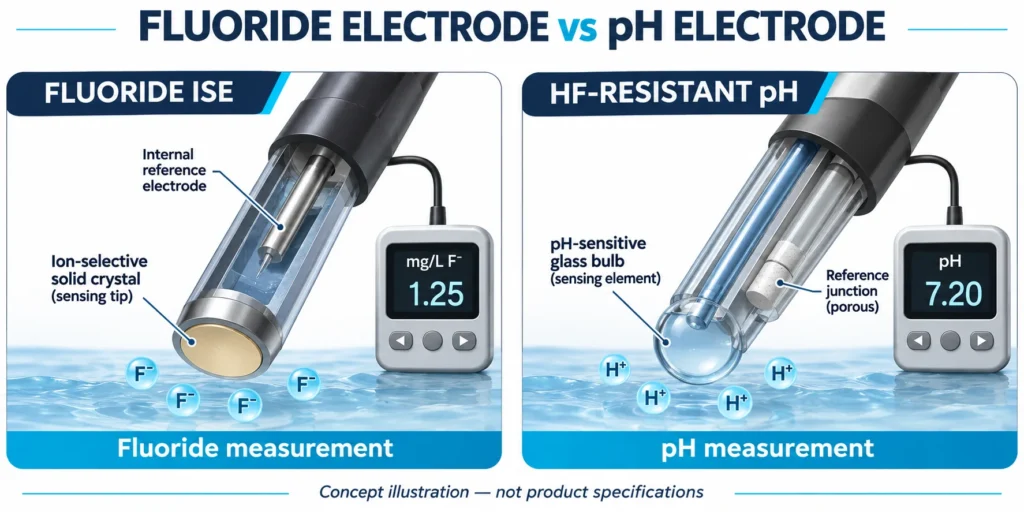
A purchase request says “fluoride-resistant electrode.” The treatment operator wants to control pH, while the laboratory wants a fluoride result in mg/L. Both people may be discussing the same wastewater, but they need different measurements.
The key difference in a fluoride ion electrode vs pH electrode comparison is the quantity measured. A fluoride ion-selective electrode responds to fluoride ion activity. An HF-resistant pH electrode measures pH and uses a glass formulation intended for a specified chemical duty. The two probes are not interchangeable.
This guide helps buyers define the measurement before choosing a probe, controller or replacement part.
Is a fluoride ion-selective electrode the same as an HF-resistant pH electrode?
No. A fluoride ion-selective electrode, or fluoride ISE, is used for fluoride analysis. An HF-resistant pH electrode is used to measure pH in media for which its materials have been approved. “HF-resistant” describes a material property; it does not turn a pH sensor into a fluoride analyzer.
Start with the result required by the plant. If the question is “What is the pH?”, specify a suitable pH loop. If the question is “What is the fluoride concentration?”, specify a fluoride measurement method. A process may need both.
Fluoride electrode vs HF-resistant pH electrode at a glance
| Selection point | Fluoride ion-selective electrode | HF-resistant pH electrode |
|---|---|---|
| Main measurement | Fluoride ion activity, interpreted through a defined analytical method | pH, related to hydrogen ion activity |
| Typical reported result | Fluoride concentration, such as mg/L as F− | pH |
| Common sensing surface | A fluoride-selective solid-state sensing element | A pH-sensitive glass membrane |
| Meaning of the material label | Identifies the ion-selective sensing system | Describes glass selected for a chemical exposure duty |
| Calibration materials | Suitable fluoride standards and any conditioning solution required by the method | Suitable pH buffer solutions |
| Instrument capability to confirm | Electrode input, fluoride or supported ISE calculation, reference and calibration | Compatible pH input, reference, temperature input and calibration |
| What it cannot establish alone | The process pH or every possible form of fluorine | Fluoride concentration or universal resistance to HF |
Use the actual probe manual to confirm the construction. A similar shaft, connector or cable is not evidence that two electrodes measure the same thing.
What does a fluoride ion-selective electrode measure?
A fluoride ISE develops an electrical potential related to the activity of free fluoride ions in the liquid. The instrument compares that response with suitable standards to calculate a result under the chosen method conditions.
The Thermo Scientific fluoride electrode user guide explains the activity response, reference system and calibration. Its procedures use total ionic strength adjustment buffer, or TISAB, to control measurement conditions. That procedure belongs to the specified method and electrode.
The phrase “fluoride reading” still needs a reporting basis. Ask whether the result represents a directly measured sample, a sample treated with a specified buffer, or a result obtained after further preparation. Keep the method name with the number.
A fluoride ISE reading should not automatically be described as total fluorine, total organic fluorine or an HF concentration. Those are different analytical requests. The electrode name alone does not establish how those results would be obtained.
Does a fluoride electrode measure HF directly?
Do not treat a fluoride ISE result as a direct HF measurement. Free fluoride, HF and fluoride associated with other constituents do not mean the same thing. Sample chemistry and preparation influence what the method reports.
For a project specification, write the required analyte and units rather than asking only for a “fluorine sensor.” Include the laboratory method currently used at the plant. This gives the supplier a concrete result to review.
What does HF-resistant mean on a pH electrode?
The sensing glass still measures pH. The HF designation concerns its suitability for a demanding medium. It does not identify a fluoride-selective membrane or a concentration measurement mode.
Hamilton's pH glass selection guide distinguishes its glass formulations, including an HF formulation for media containing hydrofluoric acid. This illustrates why the glass specification matters. It does not establish the operating limits of a Tenber electrode or another manufacturer's probe.
The complete assembly needs review. Ask about the glass, reference junction, body, seals and holder together. Confirm normal conditions, cleaning conditions and short process upsets. A material description is not a lifetime guarantee.
For a detailed pH selection checklist, use our guide to choosing a pH electrode for fluoride-containing wastewater. That page covers chemical compatibility; this comparison covers which quantity the electrode measures.
Why do pH and sample conditioning matter in fluoride analysis?
Two fluoride results can disagree even when both displays are steady. One instrument may measure untreated process water. The laboratory may test a conditioned sample. Review the methods before adjusting either instrument.
The US EPA Method 9214 describes potentiometric fluoride determination using an ion-selective electrode. Its procedure controls sample conditions with TISAB. Method details matter because pH, ionic strength and complexation can affect the result.
For an online project, ask how the proposed system handles those conditions. Does it measure directly in the process? Does it use a controlled sample stream? Are reagents, pumps or a separate analysis cycle involved? Include those parts in the supply scope.
Do not add a laboratory conditioning reagent to a process tank merely because a bench method uses it. Likewise, a pH reading from a chemically conditioned sample does not represent the original process pH. Keep the sample treatment record with each result.
Our ISE interference in wastewater guide covers the separate issue of sample suitability. Use it when a probe passes calibration but disagrees with the plant laboratory.
Can both electrodes use the same controller?
Sometimes a laboratory meter supports pH, mV and ISE modes. That does not mean every industrial pH controller can calculate fluoride concentration. Confirm the exact input and software functions.
For a fluoride measurement loop, check the electrode potential range, high-impedance input, reference connection, fluoride calibration and output units. An mV display is useful diagnostic information, but it is not a calibrated mg/L fluoride result by itself.
For a pH loop, check the pH electrode connection, temperature element and buffer calibration. The controller cannot protect chemically unsuitable sensing glass from the process.
An adapter may make a connector fit. It cannot add a missing reference circuit, change a pH input into a supported fluoride method, or verify sample compatibility. Our ISE controller compatibility checklist explains the electrical and calibration checks in more detail.
Where do Tenber PH-302 and ION-8301 fit?
Review PH-302 when the required duty is pH monitoring or control with a compatible electrode. Selecting PH-302 does not establish that a particular pH probe can withstand the stated fluoride wastewater.
For an ion measurement project, review the ION-8301 ion controller with the exact proposed ISE. Ask Tenber to confirm the input, ion calculation, reference wiring and calibration for that specific pair. The controller name alone is not confirmation of a complete fluoride analyzer package.
Send the existing electrode datasheet when replacing equipment. A photograph of the front display is useful, but the electrode label and wiring record are often more valuable for checking the replacement.
Which measurement does a fluoride wastewater project need?
Consider a treatment plant adding alkali to a mixed tank. The operator needs pH feedback for the dosing decision. A chemically suitable pH electrode belongs in that loop. Calling it a “fluoride electrode” on the order may send the supplier toward the wrong instrument.
Now consider the same plant checking fluoride removal. The required fluoride result needs its own method, range and verification plan. A pH value can describe a treatment condition; it cannot establish the fluoride concentration remaining in the outlet.
If both results matter, specify two measurement duties. Give each its own calibration record and acceptance check. Confirm whether the plant needs local indication, an alarm, automatic control or a result for a separate reporting procedure.
For projects in Vietnam, Indonesia, Malaysia and the United States, include the actual site's water chemistry and reporting requirements. Destination country does not determine which electrode measures the required quantity.
What should be included in an electrode inquiry?
Use this table before asking for a price. It helps distinguish a replacement pH probe from a fluoride analysis system and exposes missing parts in the quotation.
| Inquiry field | For pH measurement in fluoride wastewater | For fluoride measurement |
|---|---|---|
| Required result | Normal and upset pH range | Fluoride reporting basis, units and concentration range |
| Water information | Fluoride information, lowest pH, temperature and other chemicals | Sample matrix, pH, relevant interferents and current lab method |
| Sample arrangement | Tank, pipe or bypass, with mounting and access details | Direct online measurement or defined sample conditioning system |
| Hardware identity | Electrode, holder, cable and pH controller model | Fluoride ISE, reference, cable, meter or analyzer model |
| Calibration and verification | Buffer procedure and process comparison plan | Fluoride standards, conditioning procedure and independent check |
| Plant connection | Required outputs, alarms and control action | Required outputs, units, data interval and fault indication |
| Quotation scope | Probe only or complete pH loop | Probe only, controller pair or complete analysis system |
Add quantity, destination and whether this is a new installation or replacement. Request written confirmation of the proposed combination and the conditions still requiring review.
Frequently asked questions
Can pH be converted into fluoride concentration?
No general conversion applies. pH and fluoride concentration are separate quantities. Knowing the pH of a wastewater sample does not establish its fluoride content. Use an appropriate fluoride analytical method for that result.
Can a fluoride ISE be calibrated with pH buffers?
Use the fluoride standards and conditioning procedure specified for the fluoride method. pH buffers serve a different calibration purpose. An acceptable pH calibration does not verify the fluoride response.
Is an HF-resistant pH electrode suitable for every fluoride stream?
No. Confirm the specific model against the full process and cleaning conditions. The material label alone does not define its approved chemical exposure or expected service life.
What should I order if the specification only says “fluoride-resistant electrode”?
Clarify the required result first: pH or fluoride concentration. Then obtain the electrode model, controller input, sample conditions and complete supply scope. Resolving that wording before ordering can prevent an incompatible replacement.
Send Tenber your pH or ion measurement requirements for a review of the proposed electrode and controller arrangement. Include the process data and existing equipment details so the quotation addresses the actual measurement duty.