Need help selecting a wastewater pH controller?
Tell us your water application, measuring range and output requirement. We will recommend a suitable model.
An industrial pH controller for wastewater must be selected with the electrode, installation point and control system. Start with the liquid chemistry, expected range, temperature, pressure, suspended solids, fouling risk and required output. Then compare PH-302, PH-303 and PHS-3301 against the complete measuring loop.
Need help selecting a wastewater pH controller?
Tell us the wastewater type, range, temperature, installation and PLC or dosing-control requirement.
Industrial wastewater pH controller: quick selection
| Project condition | Selection direction | What must be confirmed |
|---|---|---|
| PLC accepts analogue signals only | Shortlist a model with the required isolated 4–20mA channel count. | Channel mapping, isolation, load, temperature input and electrode. |
| PLC or SCADA needs Modbus | Shortlist a model with documented RS485 Modbus RTU. | Address, baud rate, register mapping, cable and control-system settings. |
| Automatic dosing or alarm is required | Confirm relay count and logic on the exact controller. | Relay direction, setpoint, delay, fail state and interlock. |
| High solids, oil or chemical exposure | Choose the sensor and installation arrangement before finalising the controller. | Liquid composition, cleaning method, pressure, temperature and service access. |
Where to measure pH in a wastewater system
Common measurement points include an equalization tank, neutralization tank, chemical dosing line, biological treatment stage and discharge-monitoring point. The correct point depends on the process decision. A sensor beside a concentrated dosing stream may not represent the mixed liquid, while a poorly accessible immersion point can make calibration and cleaning difficult.
What to confirm before choosing the controller
- Define the liquid, treatment stage and expected pH or ORP range.
- Record normal and maximum temperature, pressure and flow conditions.
- Describe solids, sludge, oil, scaling or chemical exposure that may foul the electrode.
- Choose tank, pipe, bypass or flow-cell installation with maintenance access.
- Confirm 4–20mA, RS485 Modbus RTU, relay, alarm and dosing-control requirements.
- Match the electrode, temperature input, cable and connector to the controller.
PH-302 vs PH-303 vs PHS-3301
| Model | Documented interface | When to shortlist | Important limitation |
|---|---|---|---|
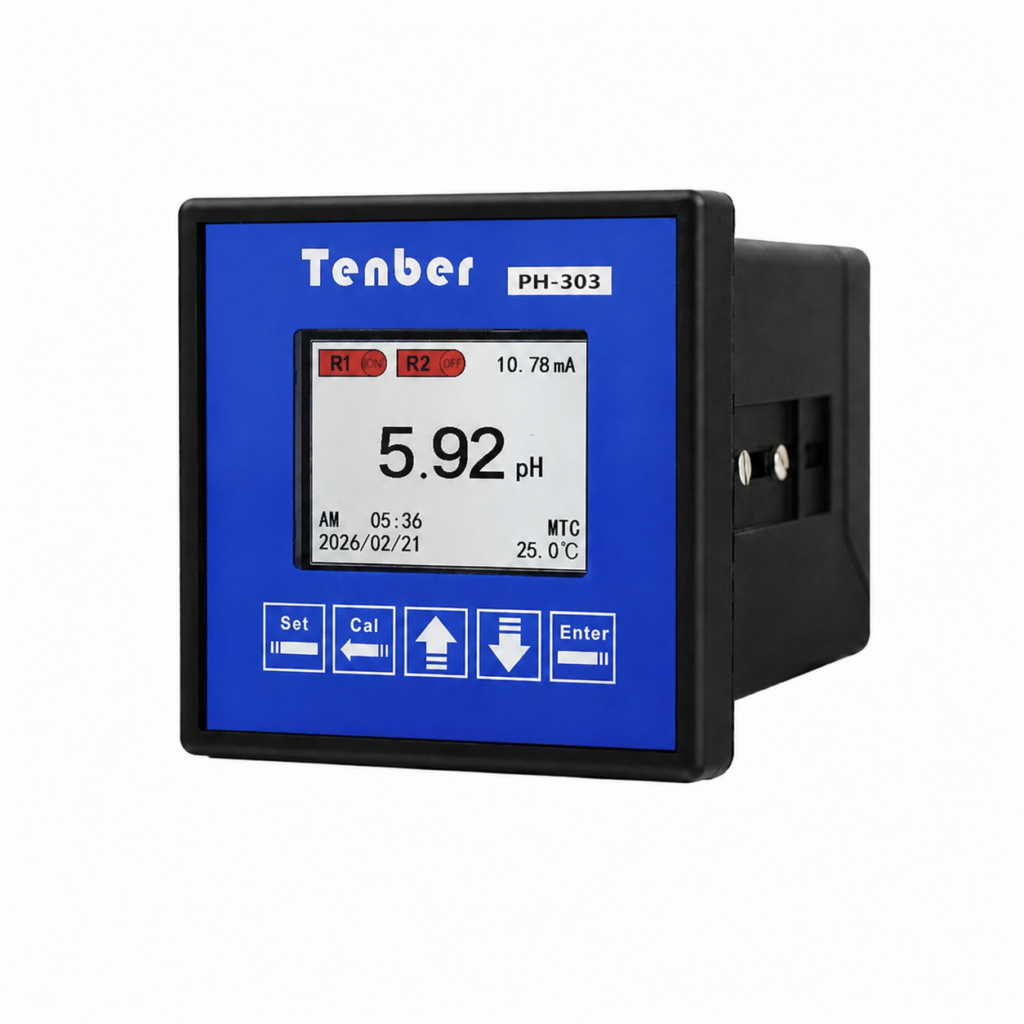
| PH-303 | Two isolated 4–20mA outputs | Two analogue channels are required for a pH/ORP measuring loop. | Do not assume RS485 or relay functions without current model documentation. |
| PH-302 | One isolated 4–20mA, RS485 Modbus RTU and two relay controls | Compact panels need analogue, digital communication and relay functions. | Confirm output scaling, Modbus settings, relay logic and electrode. |
| PHS-3301 | Two isolated 4–20mA, RS485 Modbus RTU and broader documented functions | The project needs broader integration or record functions. | Confirm panel opening, sensor input, relay functions and records. |
Select the pH sensor as part of the loop
The controller does not determine chemical compatibility by itself. Confirm the electrode material, reference arrangement, temperature probe, pressure rating, cable length, mounting and cleaning method. If the process contains strong chemicals, oil, solids or fluoride-containing media, send the complete chemistry before quotation.
Common wastewater controller mistakes
- Selecting by pH range only.
- Placing the sensor directly beside a concentrated chemical feed.
- Choosing the controller before confirming the electrode and temperature input.
- Assuming every pH controller has RS485, relay outputs or the same signal mapping.
- Failing to plan calibration, cleaning and sensor removal.
Current Tenber Models at a Glance
PH-303, EC-702 and EC-703 are current product routes for different measurement parameters. They are not interchangeable.
| Model | Main measurement | Integration direction | When to shortlist | Confirm before ordering |
|---|---|---|---|---|
| PH-303 | pH / ORP / temperature | Two isolated 4–20mA outputs | Two analogue channels are required. | Electrode, temperature input, mapping, mounting and power. |
| EC-702 | Conductivity-related measurement | Dual isolated 4–20mA and RS485 Modbus RTU | Conductivity monitoring needs analogue and digital integration. | Range, cell constant, sensor, temperature, pressure and installation. |
| EC-703 | Conductivity-related measurement | Analogue-focused route; confirm current variant | A simpler conductivity loop may fit when the analogue interface is confirmed. | Current manual, range, outputs, sensor and communication. |
What to include in a quotation request
Send the wastewater type, liquid chemistry, pH or ORP range, temperature, pressure, installation method, electrode, output or communication interface, control requirement, quantity and destination country. Tenber will review the complete configuration before quotation.
Tell us your water application, measuring range and output requirement.
We will recommend a suitable model and identify the technical details that still need confirmation.
Frequently Asked Questions
Can I choose the controller from the pH range alone?
No. The liquid, sensor, temperature, pressure, installation, output and maintenance conditions must be checked as one measuring loop.
Are PH-303, EC-702 and EC-703 interchangeable?
No. PH-303 is a pH/ORP route, while EC-702 and EC-703 are conductivity-related routes.
What information should I send?
Send the application, liquid, range, temperature, pressure, installation, output or communication requirement, quantity and destination country.
Suitable use and selection boundary
This guide supports wastewater-treatment engineers, system integrators, OEM panel builders and procurement teams that need a documented pH/ORP controller shortlist before quotation. It does not replace a site engineering review, hazardous-area approval, regulatory decision or chemical-compatibility guarantee.
Send the parameter, liquid composition, pH/ORP range, temperature, pressure, installation, cable length, electrode, temperature input, analogue channels, Modbus requirement, relay logic, panel cutout, quantity and destination country. Tenber can then review the controller, electrode and installation as one configuration.