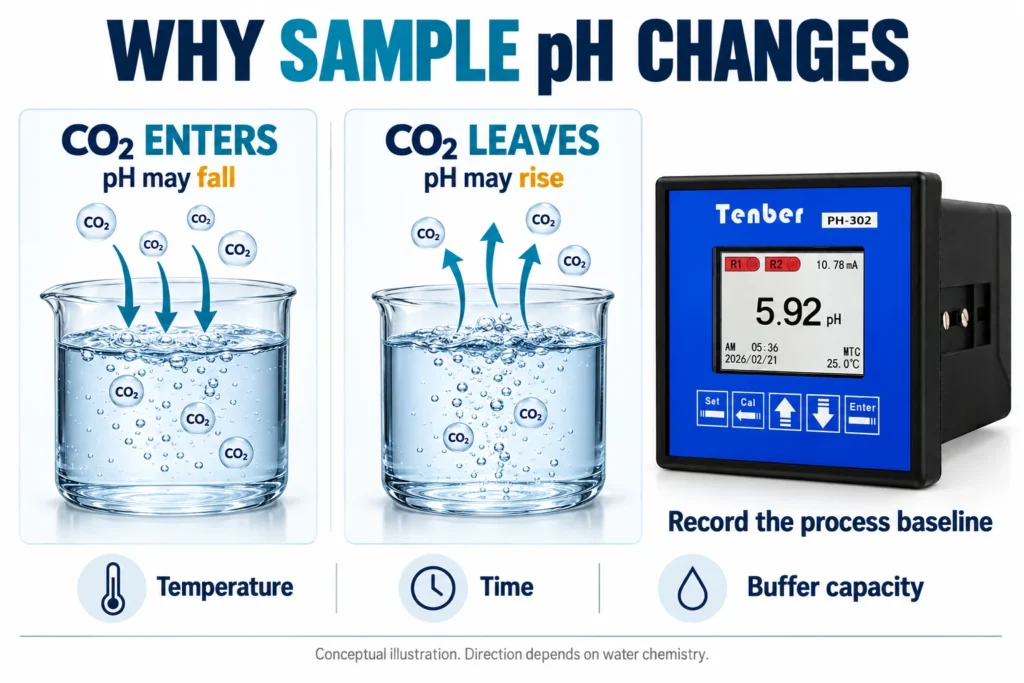
If your pH sample changes after collection, the water may be reacting with air or changing during handling. Carbon dioxide entering the water can lower pH. Carbon dioxide leaving the water can raise it. Temperature, ongoing reactions and contamination can also affect the result. Measure promptly at the sampling point and record both pH and temperature.
A bottle does not freeze the chemistry of the water inside it. A later reading may describe the sample as it is now, rather than the process as it was when the sample was taken.
This guide focuses on changes in the collected water. For a full instrument comparison, see our guide to online versus laboratory pH readings.
Why does the pH of a water sample change after collection?
The sample enters a new environment when it leaves a pipe, tank or well. Contact with air, changes in temperature and pressure, and reactions inside the container can shift its pH. Absorbing carbon dioxide often lowers pH; losing carbon dioxide can raise it. The direction and size of the change depend on the water chemistry.
Do not assume that every collected sample becomes more acidic. First ask whether gas is entering or leaving the water, whether the temperature has changed, and whether the measurement method is sound.
How does carbon dioxide change sample pH?
Carbon dioxide, or CO₂, can dissolve from the air into water. Some dissolved CO₂ reacts with water to form carbonic acid. The acid-base balance can release hydrogen ions and lower pH.
A simplified description is:
CO₂(aq) + H₂O ⇌ H₂CO₃ ⇌ H⁺ + HCO₃⁻
This is an equilibrium, not a reaction that converts all dissolved CO₂ into carbonic acid. A lower pH also does not mean the water must end up below pH 7.
The reverse change matters too. Water containing more CO₂ than is in equilibrium with the surrounding air can release it after collection. That loss can raise pH. The USGS discussion of sample gas exchange explains that CO₂ may enter or leave a sample and affect pH.
Why does sample pH sometimes fall?
CO₂ absorption is one possible cause, especially when the water has little resistance to an acid input. It is not a diagnosis from the pH trend alone. Residue in the bottle, a changing sample temperature or other reactions may also contribute.
Why does sample pH sometimes rise?
CO₂ loss is one possible cause. For example, water brought out of a CO₂-rich environment may release gas as conditions change. The USGS groundwater sampling report describes how pressure and temperature changes can promote degassing, and how losing CO₂ can raise pH.
An upward trend does not prove that the online controller is reading too low. Check the sample history before changing a calibration or dosing setting.
Does alkalinity affect the amount of pH drift?
Yes. Alkalinity describes the water's ability to neutralize acid. Water with more buffering capacity generally resists a pH change better than poorly buffered water under a comparable acid input. USGS explains alkalinity and buffering capacity.
Alkalinity and pH are different measurements. A single pH value cannot tell you how strongly the sample is buffered. Two samples with the same starting pH may respond differently to air exposure.
Do not assign a fixed pH correction from exposure time alone. The starting chemistry, gas conditions, mixing and temperature all matter.
What else can change the result after sampling?
| Change after collection | Why it matters | What to record |
|---|---|---|
| CO₂ enters the water | pH may fall | Air exposure and handling |
| CO₂ leaves the water | pH may rise | Pressure change, bubbles and transfers |
| Sample warms or cools | Chemical equilibria and electrode response can change | Temperature at each reading |
| Reactions continue in the bottle | The collected water may evolve | Time, visible deposits and sample condition |
| Container or probe carries residue | Contamination can alter the sample | Bottle preparation and rinse method |
| Electrode response drifts | The displayed change may include a measurement problem | Buffer checks and probe condition |
A moving reading can reflect a changing sample, a sensor problem, or both. Do not use the direction of drift as proof of one cause.
USGS field guidance describes pH changes from gas loss, mineral precipitation and other reactions soon after collection. The current USGS pH field manual covers equipment, calibration and measurement procedures for most natural waters. Industrial samples need a method suited to their own chemistry.
How can you reduce sample changes before pH measurement?
Measure near the process point
Use an approved field method as close as practical to the sampling point and collection time. Where the application permits, an in-place measurement or suitable flow-through arrangement can reduce handling changes.
A closed flow cell still needs a sound design. Review flow, pressure, temperature and sample-line delay. It is not a universal fix for every liquid.
Avoid unnecessary exposure and transfers
Use a clean, suitable container and minimize needless splashing, shaking and pouring. If the method calls for a capped container or controlled headspace, follow that requirement. A lid can reduce further gas exchange, but it cannot undo a change that already occurred.
Do not add acid, alkali or another preservative to hold the original pH. That would change the property you are trying to measure. Follow the specified method for any sample that must be transported.
Record temperature with every pH value
Automatic temperature compensation addresses the electrode's temperature response. It does not generally reverse chemical changes caused by CO₂ exchange or cooling.
Do not assume that placing an old sample back at its first temperature restores its first pH. Read the pH temperature compensation guide when reviewing the instrument setup.
Check the reference meter before blaming the sample
Verify the meter with suitable fresh buffers and inspect the electrode. A slow, dirty or unsuitable probe can make a sample study misleading. Allow the probe to settle under the method's conditions.
Use the separate handheld versus online pH field guide for the paired instrument-check procedure.
How do you investigate a sample that changes while standing?
Build a short record before making an adjustment. The goal is to separate an observed change from an assumed cause.
- Identify the process point, sampling method and purpose of the test.
- Record the online pH, process temperature and collection time.
- Measure the fresh sample using the approved reference method. Record temperature and test time.
- If a time study is useful, log later readings with their elapsed times and handling conditions.
- Check the reference meter again if its response becomes doubtful.
- Repeat with a fresh sample before changing the online loop.
A sample time study is a troubleshooting exercise. It does not replace a required field or laboratory method. Do not deliberately age a compliance sample to obtain a preferred result.
A sample-change log
| Record field | Entry to make |
|---|---|
| Source and sample ID | Exact point and bottle identification |
| Collection | Time, process state and temperature |
| Process baseline | Online pH and matching timestamp |
| Fresh sample result | pH, temperature and test time |
| Later observations | Elapsed time, pH, temperature and exposure |
| Measurement checks | Meter ID, probe condition and buffer results |
| Interpretation | Observed trend, possible cause and next check |
Keep original values in the record. If the sample was transported or left open, say so. A clear handling history is more useful than an unexplained offset.
How can the Tenber PH-302 help establish a process baseline?
A suitable online installation can record the process condition at the time a sample is collected. The Tenber PH-302 pH/ORP controller supports one isolated 4–20 mA output, RS485 Modbus RTU and two relay control points, according to its current product information.
Connect it to suitable recording equipment when time-stamped trends are required. Confirm the electrode, temperature input, output mapping and receiving system against the current documentation. Remote data access requires the appropriate external system and network.
PH-302 does not preserve a collected sample or reconstruct its original chemistry. Its value here is the process reference. Use a suitable pH sensor installation and maintain the complete measuring loop.
For projects in Vietnam, Indonesia, Malaysia or the United States, include the water type, sampling arrangement, temperature, observed delay and required signals in your inquiry. Ask Tenber to review the PH-302 measurement loop.
Frequently asked questions
Does air always make a water sample more acidic?
No. CO₂ uptake can lower pH, while CO₂ loss can raise it. Other changes may occur at the same time. The water chemistry determines the overall result.
How quickly can sample pH change?
There is no single stable period for every sample. Changes may occur soon after collection. Measure promptly using the required method and record the actual delay rather than assuming the sample stays unchanged.
Can I correct an old sample back to its original pH?
Not with a universal formula. Time, temperature and the later pH reading do not fully describe the original water chemistry or gas exchange. Collect a fresh sample when the original process condition must be checked.
Does a sealed bottle guarantee stable pH?
No. Sealing may limit further gas exchange, but temperature changes and reactions within the bottle can continue. Use the correct container and method, and measure without avoidable delay.
Should I adjust PH-302 to match a delayed sample?
First verify the reference meter and review sampling, timing and temperature. A delayed sample may no longer represent the installed sensor's conditions. Follow the approved comparison and calibration procedure before any adjustment.
Prepared by Tenber Technical Team. Updated October 29, 2026. General sampling guidance; no site trial, universal holding time or acceptance tolerance is claimed.