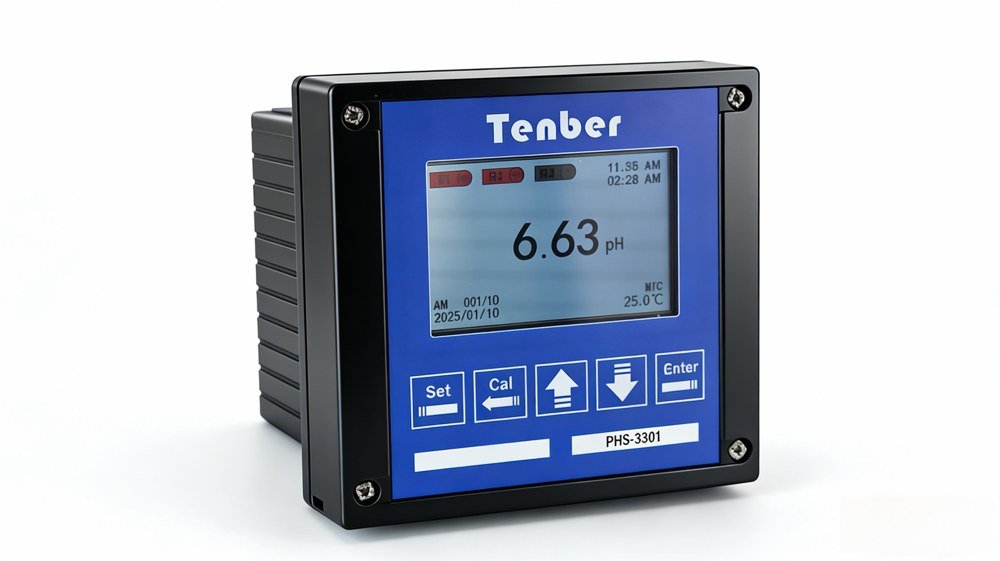
Product Overview
Industrial ion controller with selectable ppm ranges, dual isolated 4–20mA outputs and RS485 Modbus RTU.
Technical Specifications
Continuous ion monitoring with application-matched electrodes
Tenber TB-8301 is designed for continuous ion and temperature measurement in wastewater and environmental monitoring. It connects to compatible ion-selective electrodes selected for the target ion, concentration range and actual process conditions.
Verified Technical Data
| Selectable ranges | 0.00–20.00 / 0.0–200.0 / 0.0–2000.0 / 0–20000 ppm |
|---|---|
| Voltage input | 0.0–1000.0 mV |
| Temperature compensation | Pt1000 / NTC10K |
| Analog outputs | Two isolated 4–20mA outputs |
| Communication | RS485 Modbus RTU |
| Data logging | Up to 500,000 records |
| Power | 90–260 VAC |
Typical Monitoring Applications
The TB-8301 can be considered for suitable industrial wastewater, process-water and environmental monitoring projects that require continuous ion measurement. The final application depends on the available ion-selective electrode and the chemical composition of the sample.
Common project requirements include local concentration display, alarm supervision, analog transmission to a PLC and digital data collection through RS485 Modbus RTU. The controller’s dual isolated 4–20mA outputs allow concentration and temperature information to be integrated into a wider monitoring or control system when configured for the project.
Ion-Selective Electrode Matching
The electrode is the application-specific part of the measuring system. Before selection, confirm the target ion, expected concentration range, interfering ions, pH, temperature and sample condition. Strong changes in ionic strength, chemical interference, coating or sediment can influence measurement performance.
Tenber reviews the application information before recommending a controller-and-electrode combination. Where possible, provide a water analysis, process description or sample information. This helps determine whether direct immersion, flow-through measurement or a conditioned sample arrangement is more appropriate.
Installation and Commissioning
Install the electrode at a representative measuring point with stable contact with the sample. Avoid stagnant areas, severe air entrainment and locations where solids may bury or damage the sensing element. The installation should allow safe removal for inspection, cleaning and calibration.
During commissioning, confirm the selected range, temperature compensation, analog outputs, relay logic and Modbus communication. Compare the online result with the customer’s accepted laboratory or process reference under stable conditions before using the signal for automatic control.
Maintenance Guidance
Ion-selective electrodes require application-based maintenance. Inspect the sensing surface, clean deposits with a method suitable for the electrode, and verify the response using appropriate standards. Calibration frequency should be decided from process stability and the customer’s accuracy requirements.
Frequently Asked Questions
Can one electrode measure every ion?
No. A compatible ion-selective electrode must be selected for the target ion and sample chemistry.
What information is needed before quotation?
Send the target ion, expected range, pH, temperature, possible interfering ions, installation method, output requirements and quantity. Tenber will review the complete configuration.
View the ion controller range or browse all industrial water quality instruments.
Confirm the complete measuring configuration
Send the liquid, measuring range, temperature, pressure, installation method, output signal and quantity. Tenber will check the controller and sensor combination before quotation.