How does a pH sensor work?
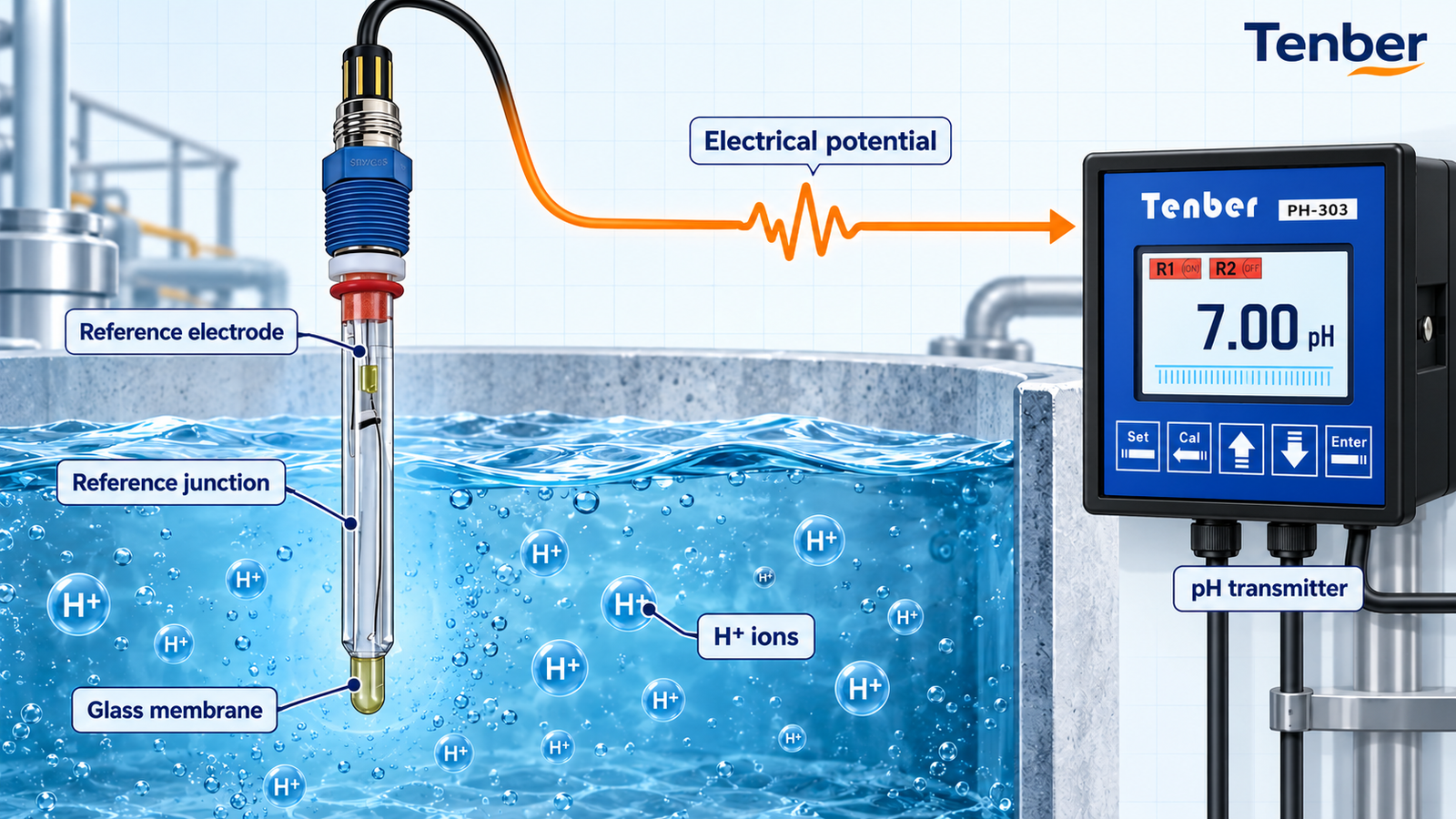
A pH sensor measures hydrogen ion level with a glass membrane and a reference electrode. The membrane creates a small voltage that changes with pH. A meter, transmitter or controller reads this voltage and calculates the pH value. In industrial water treatment, good results also require correct calibration, temperature input, installation and cleaning.
What is a pH sensor?
A pH sensor is the sensing part of a pH measurement system. Most industrial pH probes use a combination electrode. It contains a glass measuring membrane and a reference system in one body.
A complete pH sensor may include:
- A special glass membrane.
- An internal liquid and internal reference.
- An external reference junction.
- A sensor body, cable and connector.
- A temperature element for temperature compensation.
The sensor normally does not show the pH value. It sends a weak electrical signal to a pH meter, pH transmitter or pH controller. The electronics then display the value or send it to a PLC, DCS, alarm or dosing system.
This is why sensor selection should not be based on the word “pH” alone. The electrode, controller, temperature input, cable and installation point must work together.
What is the pH electrode working principle?
The pH electrode working principle uses a voltage across a special glass membrane. The hydrated outer surface of the glass responds to hydrogen ion level in the sample.
The inside of the membrane contacts an internal solution. The outside contacts the process liquid. If the hydrogen ion level differs on the two sides, the membrane voltage changes.
The measuring electrode gives a relative voltage. It needs a reference electrode for comparison. The reference junction creates ionic contact with the process liquid. The meter measures the difference between both electrodes and converts it into pH.
This simple view explains the two main parts of a pH probe:
- The glass electrode responds to the process liquid.
- The reference electrode supplies a stable comparison point.
A blocked reference junction can cause drift even when the glass bulb looks clean.
How does a glass electrode measure pH?
A glass electrode does not count hydrogen ions directly. It responds to hydrogen ion level through a membrane voltage.
At about 25 °C, the ideal response is close to 59 mV for one pH unit. Temperature changes the slope. Age and dirt also affect the slope. This is why a pH sensor needs calibration.
The Nernst equation is often used to explain this response. It links voltage, temperature and pH. It is a theory guide, not a replacement for calibration. Each electrode has its own offset and slope. The controller must use data from the actual sensor.
For a complete industrial loop, review the Tenber industrial pH sensor range and the Tenber pH/ORP controller category.
What does the reference electrode do?
The reference electrode gives the meter a stable electrical reference. A porous junction allows ionic contact between the reference system and the process liquid.
The reference junction is a common maintenance point. Coating, scale, crystals, air bubbles or a wrong filling condition can increase resistance. They can also create an unstable junction voltage.
Typical reference-side symptoms include:
- The value stabilizes very slowly.
- The value changes when the cable moves.
- Online pH differs from a fresh sample.
- Calibration points do not repeat.
- The offset becomes larger after cleaning.
- The sensor reacts but cannot hold a stable value.
When a pH reading is unstable, inspect the electrode, reference junction, cable, connector, sample flow and grounding. Do not replace the controller first.
Why is temperature compensation important?
Temperature changes the theoretical slope of a glass electrode. Automatic temperature compensation, or ATC, uses a temperature input to adjust the meter response.
ATC improves the electrical interpretation of the sensor signal. It does not correct every temperature effect. It does not repair:
- A coated or aged sensor.
- A blocked reference junction.
- Poor mixing or a bad sampling point.
- A temperature probe in another liquid stream.
- An incorrect temperature probe setting.
- A real chemical pH change caused by temperature.
Before ordering, confirm the temperature element, wiring and controller input. The pH electrode and temperature input must match the controller variant.
What is the difference between a pH sensor and a pH transmitter?
These terms describe different parts of the measurement system.
| Term | Main function | Check before selection |
|---|---|---|
| pH sensor or pH probe | Contacts the liquid and creates the measurement signal | Glass type, reference system, body, cable, mounting and temperature element |
| pH electrode | The measuring and reference sensor assembly | Connector, junction, internal liquid, calibration and chemical fit |
| pH transmitter | Receives the electrode signal and sends it to another system | Input, isolation, 4–20 mA, RS485, scaling and power |
| pH controller | Measures and may display, alarm or control | Output, relay, communication, control logic and exact variant |
A sensor cannot replace the transmitter or controller. The electronics cannot compensate for a sensor that is wrong for the liquid.
How does an online pH measurement system work?
A typical industrial pH measurement system has seven steps:
- Install the pH electrode at a good sample point.
- Let the glass membrane and reference junction contact the process liquid.
- Measure temperature when the setup uses temperature compensation.
- Send the weak electrode signal to the controller.
- Use calibration data to calculate pH.
- Send the value to a display, PLC, DCS, alarm or dosing system.
- Compare the result with the process target and maintenance condition.
The installation point matters as much as the controller. Poor mixing, bubbles, dead zones and a stagnant bypass can produce a value that does not represent the process.

For a PLC project, review pH transmitter integration for PLC systems. For a current model starting point, review the Tenber PH-303 pH/ORP controller and confirm the exact sensor input before quotation.
How should an industrial pH sensor be calibrated?
Use fresh buffer solutions that cover the expected measurement range. Follow the current sensor and controller manual because procedures vary by model.
A general workflow is:
- Inspect the glass bulb, reference junction, cable and connector.
- Clean the electrode for the type of dirt.
- Rinse the electrode without rubbing the glass aggressively.
- Stabilize it in the first buffer.
- Accept the point only when the value is stable.
- Rinse and repeat with a second buffer if required.
- Check the slope and offset against the permitted limits.
- Record the date, buffers, temperature and operator.
Calibration cannot repair a damaged glass membrane or exhausted reference system. If calibration fails repeatedly, inspect the sensor and installation before changing controller settings.
Which pH sensor is suitable for wastewater?
Choose a pH sensor from the process conditions, not only from the expected pH range.
Liquid chemistry
Record acids, alkalis, solvents, oxidizers, oils, solids and likely deposits. A sensor for clean process water may not suit dirty wastewater or aggressive chemicals.
Temperature and pressure
Confirm normal and peak temperature, pressure and thermal cycling. Also confirm whether the sensor will be in a tank, pipe, bypass or flow cell.
Fouling and cleaning
Consider biological growth, scale, grease and chemical deposits. A fouling application may need a different junction, mounting point or cleaning plan.
Mechanical and electrical fit
Check the connector, cable length, temperature element, mounting, insertion depth and controller input. Chemical fit alone does not guarantee installation fit.
Control requirement
Confirm whether the project needs local display, 4–20 mA, RS485 Modbus RTU or relay contacts. Verify each function for the exact controller and sensor combination.
What is suitable and not suitable for a pH sensor?
Suitable applications
- Continuous pH monitoring in water and wastewater treatment.
- Neutralization and chemical-dosing supervision after loop validation.
- Industrial process-water monitoring with a compatible electrode and controller.
- PLC, DCS or recorder integration with a supported signal.
- Distributor, OEM and engineering projects with clear process conditions.
Not suitable without further review
- Choosing an electrode only from the pH number.
- Using a laboratory electrode as an industrial online sensor.
- Treating ATC as a correction for every temperature effect.
- Connecting a sensor without checking the input and connector.
- Starting automatic dosing from an unstable measurement.
- Claiming universal sensor life, accuracy or chemical fit.
What should you confirm before requesting a quotation?
Send the liquid composition, normal and peak pH, temperature, pressure, solids or oil, installation method, insertion depth, cable length, connector, temperature element, controller model, output signal, cleaning plan, quantity and destination country.
Use the Tenber pH electrode selection guide for industrial wastewater to review the sensor side. Then use the pH sensor and controller quotation page to request a setup review.
Frequently asked questions
Does a pH sensor measure hydrogen ions directly?
No. The glass electrode responds to hydrogen ion level by creating a membrane voltage. The meter compares it with the reference electrode and calculates pH.
Can a pH sensor work without a reference electrode?
A practical combination electrode needs a stable reference function. Without it, the voltage comparison is not reliable for normal industrial measurement.
Why does a pH sensor need calibration?
The offset and slope change with age, dirt, temperature and process use. Buffer calibration helps the controller convert voltage into a usable pH value.
Is ATC the same as correcting sample pH?
No. ATC mainly adjusts the electrical response of the electrode. The actual chemical pH can also change with temperature.
Can one pH sensor fit every wastewater application?
No. Wastewater differs in chemistry, solids, fouling, temperature, pressure and installation. Selection must match the liquid and maintenance plan.
Sources, author and update record
- Primary sources: IUPAC Gold Book definition of pH; NIST ion-selective electrode reference; current Tenber pH sensor and controller documentation.
- Related manuals: Tenber PH-302 manual and Tenber PHS-3301 manual.
- Author: Tenber Technical Team.
- Last updated: October 16, 2026.
- Editorial note: Confirm sensor limits, fit, output mapping and supplied options against the current manual before ordering.