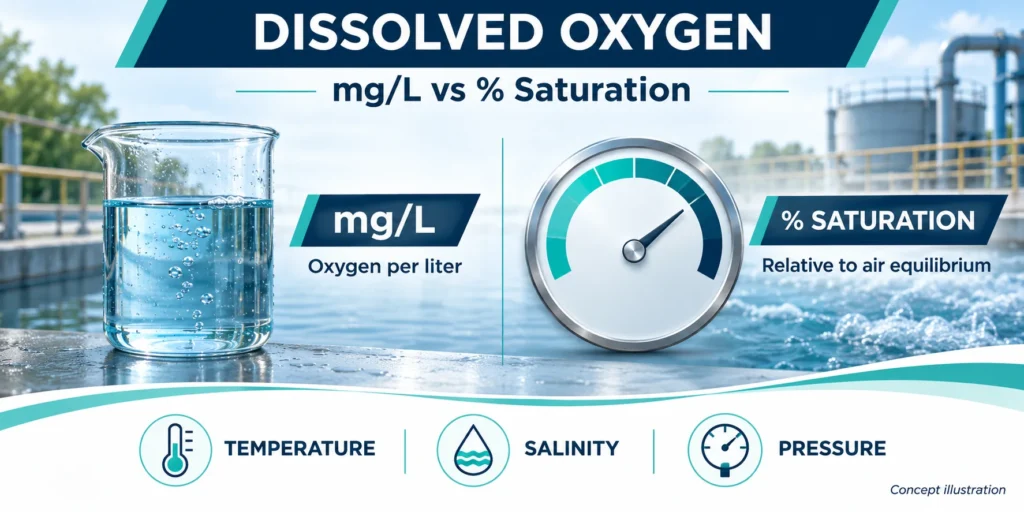
Dissolved oxygen in mg/L tells you the mass of oxygen in each liter of water. Percent saturation tells you how that reading compares with air-equilibrium conditions. They describe the same sample in different ways. You cannot convert between them with one fixed multiplier: water temperature, salinity and the pressure reference matter.
For an operator, the useful question is simple: does the control loop need an oxygen concentration, or a comparison with air saturation?
What is the difference between dissolved oxygen mg/L and percent saturation?
The main difference in dissolved oxygen mg/L vs percent saturation is the reference. Concentration measures an amount per volume; saturation compares that amount with an equilibrium value.
| Reading | What it means | Practical use |
|---|---|---|
| DO in mg/L | Milligrams of dissolved oxygen per liter | Track a concentration target in an aeration tank |
| DO in % saturation | Oxygen level relative to a defined air-saturation reference | Compare water with air equilibrium |
| 100% saturation | Equilibrium with air under the stated reference conditions | Check context; it is not a universal mg/L value |
| Above 100% | Supersaturation relative to that reference | Check the process and measurement before judging the result |
A display of 100% does not mean the water is pure oxygen. It also does not mean every treatment process has enough oxygen. Biological demand, mixing and the location of the probe still matter.
How do you convert DO percent saturation to mg/L?
For a local air-saturation basis, use:
DO (mg/L) = saturation (%) ÷ 100 × equilibrium DO concentration (mg/L)
To work in the other direction:
Saturation (%) = measured DO (mg/L) ÷ equilibrium DO concentration (mg/L) × 100
First find the equilibrium concentration for the sample's temperature, salinity and local barometric pressure. The USGS DOTABLES calculator provides this calculation. Do not reuse a freshwater value for saline water.
For example, assume the applicable equilibrium value is 8.0 mg/L. A reading of 60% gives 0.60 × 8.0 = 4.8 mg/L. If the applicable value is 10.0 mg/L, the same 60% gives 6.0 mg/L. These are worked examples, not Tenber test results or operating setpoints.
Why can two meters show different percentages?
Check what each meter calls “DO%.” Some instruments offer different pressure-reference modes. A percentage referenced to standard pressure cannot be compared directly with one corrected to local pressure. YSI's explanation of DO measurement units describes this distinction.
Match the reference mode before using the formula. For pressure entry and calibration checks, see our DO pressure-correction guide.
Why does the same saturation percentage give a different mg/L reading?
Oxygen solubility changes with the water and its surroundings. At air equilibrium, colder freshwater generally holds more oxygen than warmer freshwater. Saline water holds less than freshwater at the same temperature and pressure. Lower atmospheric pressure also reduces the equilibrium concentration.
This matters in warm outdoor tanks and coastal sites in Vietnam, Indonesia, Malaysia and the United States. Use measured site conditions rather than a country-wide assumption.
| Change, with other conditions held constant | Effect on equilibrium DO concentration | What to check |
|---|---|---|
| Water becomes warmer | Decreases | Temperature reading and sensor condition |
| Salinity increases | Decreases | Measured salinity or the configured value |
| Atmospheric pressure falls | Decreases | Local absolute pressure and meter reference mode |
| Process oxygen demand rises | Can lower actual DO without changing the equilibrium reference | Loading, aeration and mixing |
Temperature compensation does not add oxygen to the tank. It helps the instrument interpret the sensor signal. Keep compensation settings separate from changes in the actual process.
Which unit should you use for an aeration controller?
Use the unit specified by the process design. If the required setpoint is in mg/L, keep the controller, PLC trend and alarm labels in mg/L. A fixed percentage setpoint will not represent a fixed oxygen concentration as conditions change.
Percent saturation can add useful context, but it should not silently replace a concentration target. There is no single DO setpoint suitable for every wastewater process.
Before commissioning:
- Confirm the required unit and approved process setpoint.
- Check temperature, salinity and pressure settings against the manual.
- Confirm whether the controller supports both units and how it defines DO%.
- Match the selected output range to the PLC scaling and engineering-unit label.
- Test the low-DO alarm and record the settings for the next operator.
Our dissolved oxygen controller selection guide covers sensor matching and control requirements. Compare optical and membrane DO sensors when maintenance needs influence the choice.
Can dissolved oxygen exceed 100% saturation?
Yes. Photosynthesis, gas injection and changing physical conditions can produce supersaturation. A high value alone does not prove sensor failure. Check bubbles on the sensing surface, temperature, reference settings and calibration before changing the process. Our DO sensor maintenance guide explains common field checks.
What should you send when requesting a DO monitoring quotation?
Send Tenber the water type, temperature range, expected DO range, required display unit and installation location. Include salinity, the PLC signal requirement and the control or alarm task. We can then discuss a suitable dissolved oxygen controller and sensor combination.
Request a DO monitoring quotation with those details so the proposal addresses the actual measurement and control conditions.