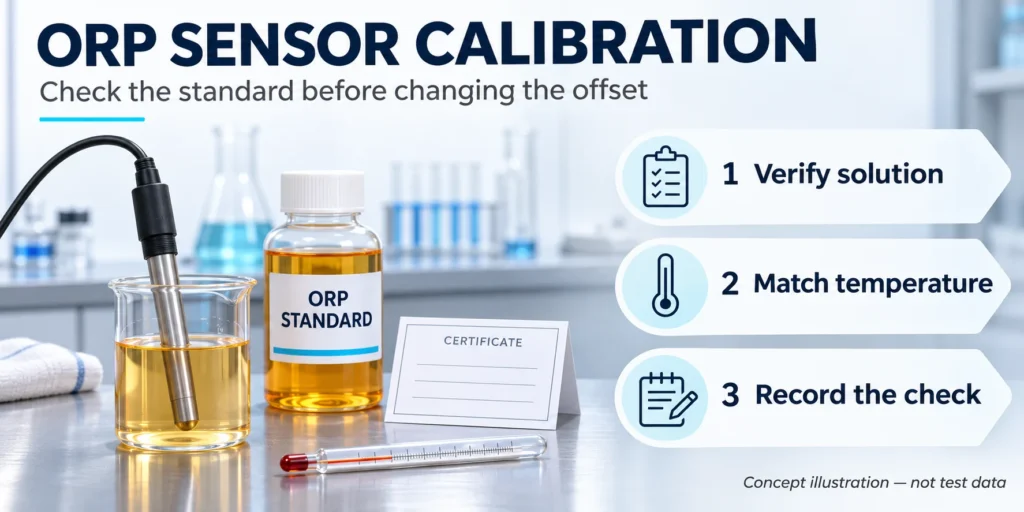
An ORP probe can read steadily yet miss the value on a standard-solution bottle. Check the temperature and reference basis before changing the offset.
To learn how to calibrate an ORP sensor, start with verification: check the clean probe and meter in a suitable redox standard. Adjust only when the manual allows it, then verify the result. Record both readings.
For the measurement basics, see what ORP means in water treatment.
How do you verify or calibrate an ORP sensor?
Verification checks a reading against a known value. Adjustment changes a supported meter setting. Confirm what the calibration menu does before using it.
Check the probe and meter together in fresh ORP standard solution. Apply the method's limits. Investigate a failed check before applying a correction.
Follow the instrument's ORP procedure; do not substitute two-point pH calibration.
Which ORP standard solution should you use?
Choose the ORP calibration solution specified by the method. Check these details:
| Standard check | Information to confirm |
|---|---|
| Solution identity | Product, lot, expiry and opening date |
| Temperature | Actual test temperature and applicable target value |
| Reference basis | Correct value for the electrode's reference system |
| Handling | Storage rules, clean vessel and fresh working portion |
| Acceptance | Method limits and the standard's stated tolerance or uncertainty |
Hamilton's ORP calibration guidance illustrates temperature tables on different reference bases. Use the values supplied with your own standard.
A value against the standard hydrogen electrode and one against Ag/AgCl use different reference bases. Confirm which value applies to the exact probe; an offset cannot resolve a reference mismatch.
Hamilton's ORP buffer guide explains solution stability. Use a fresh portion in a clean vessel. Keep used liquid out of the stock bottle and follow the storage rules.
ORP calibration procedure: a practical field checklist
Use this sequence with the current equipment manual. Follow its immersion, cleaning, stability and acceptance rules.
- Confirm the approved maintenance state for dosing, alarms and outputs. Record the initial settings and active offset.
- Inspect the sensing surface, junction, cable and plug. Clean and prepare the probe as instructed.
- Confirm the standard, temperature and correct reference value. Let the probe and solution reach the required conditions.
- Rinse as instructed and immerse both sensing and reference surfaces. Check for bubbles. Wait for stability; log mV, temperature, target and settling time.
- Apply the method's pass/fail limits. Investigate errors before making a permitted adjustment, then complete the required verification.
- Refit the probe and let the process reading settle. Verify the PLC value and restore control under the site procedure.
The Hach pHD sc sensor manual, for example, documents a one-point manual ORP correction and output-state choices during calibration. Use the exact Tenber manual for Tenber equipment.
Why does an ORP sensor disagree with the standard solution value?
Use the error pattern to choose the next check.
| Observation | Check first | Evidence to keep |
|---|---|---|
| Steady reading, fixed difference | Reference basis, temperature target and active offset | Solution certificate and electrode details |
| Reading drifts in the standard | Temperature balance, solution condition and probe preparation | Timed readings from a fresh working portion |
| Reading changes when the cable moves | Moisture, damage and connections | Inspection and approved cable checks |
| Standard passes, tank result is doubtful | Installation, fouling, sampling time and process change | A matched process comparison |
| Local value is correct, PLC is wrong | Scaling, wiring and register interpretation | Local and received values together |
If a fresh standard still fails after approved cleaning, review the reference assembly and sensor condition with the supplier.
How should you record the ORP check?
Record both model numbers, standard lot, temperature, reference basis, readings and pass/fail rule.
Suppose the correct target is +250 mV and the settled reading is +238 mV. The difference is +238 − +250 = −12 mV. This is an illustrative calculation, not Tenber test data or an acceptance limit.
Apply the actual method's limits before deciding to adjust. Check the menu's sign convention too: it may ask for the standard value rather than a signed correction.
A temperature display does not prove automatic ORP standard recognition. Check the manual. Use the industrial pH controller calibration guide for the separate pH workflow.
What should you confirm for a Tenber ORP loop?
Review the TB84R1 industrial ORP sensor and PH-302 pH/ORP controller as a specific proposed pair. Confirm the supplied configuration and current manual before choosing a check method. The ORP controller selection guide covers dosing and plant signals.
For a technical review, send both model labels, the standard label, temperature and check readings. Add the process liquid, mounting and cleaning history. State whether you need a probe, a controller or a complete loop.
Ask Tenber to review your ORP electrode and controller requirements with the model details and check record. A standard check verifies the loop under those test conditions; it does not establish a chlorine or other chemical concentration.