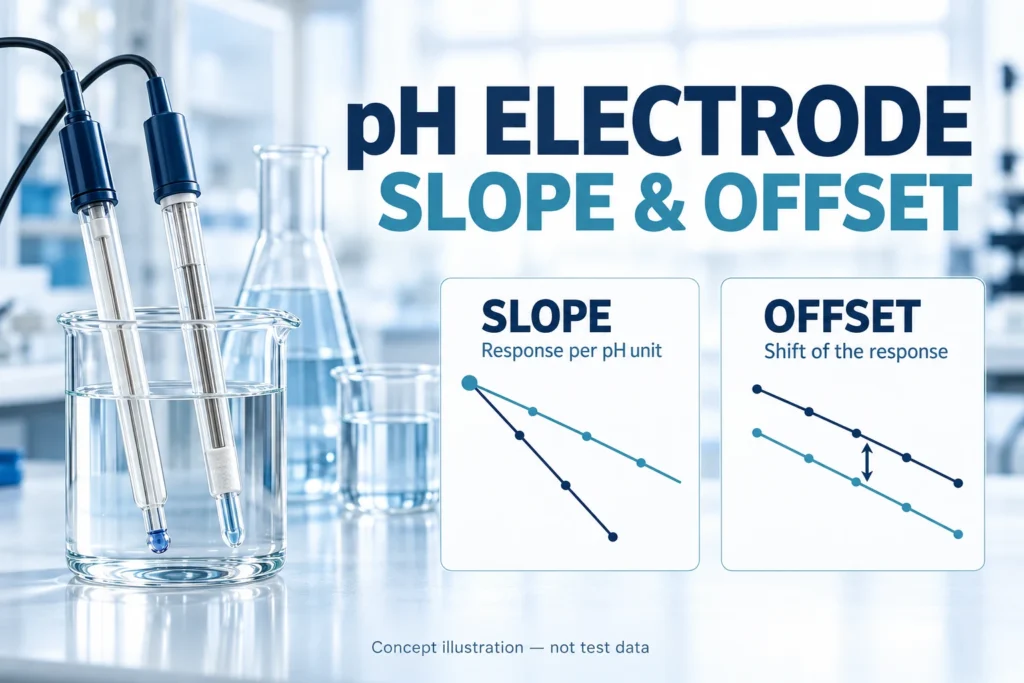
pH electrode slope and offset describe two parts of the sensor response. Slope is the voltage change for each pH unit. Offset describes the shift of that response from a reference point. Read both with the buffer values, temperature and units before deciding whether a pH electrode needs attention.
Wastewater engineers can use these numbers to check what changed. Was it the measuring loop, or the calibration conditions? This guide separates the two parameters and shows a worked example. For the operating procedure, use our industrial pH controller calibration guide.
What do pH electrode slope and offset mean?
Slope measures sensitivity; offset locates the response curve. An ideal glass pH electrode has a slope magnitude of about 59.16 mV per pH unit at 25°C. In the common pH-7 reference convention, its offset potential is near 0 mV. Real electrodes differ, so calibration determines the values for the connected measuring system.
The units matter. A slope shown as 98% is not the same quantity as 58 mV/pH. An offset shown in millivolts is not the same quantity as a zero point shown in pH units.
| Parameter | What it describes | Common display | What to confirm |
|---|---|---|---|
| Electrode slope | Voltage change per pH unit | mV/pH or percent | Signed value or magnitude; temperature basis |
| Offset potential | Voltage at a defined reference pH | mV | Reference pH and polarity convention |
| Electrode zero point | pH at which electrode voltage is zero | pH, sometimes pH(0) | Definition used by the meter |
Do not read a controller's generic “offset” menu as an electrode-health report until you check its definition. It may instead be a manual reading correction.
What is the slope of a pH electrode?
Slope tells you how far the electrode voltage moves when pH changes by one unit. A shallower response gives a smaller voltage difference between two buffers. It does not, by itself, tell you how quickly the reading settles.
Reagecon explains the Nernst response and the 59.16 mV/pH theoretical value at 25°C. For a glass electrode responding to hydrogen-ion activity, the ideal slope magnitude varies with absolute temperature:
S(T) ≈ 59.16 × (T + 273.15) / 298.15 mV/pH, where T is in °C.
This is a theoretical reference, not a factory test result. A meter may report a slope normalized to 25°C or use the calibration temperature. Check which convention applies before comparing records. See our pH temperature-compensation guide for the wider measurement issue.
Is a negative slope a fault?
Not necessarily. Under a common voltage convention, electrode potential falls as pH rises, so the signed slope is negative. Many instruments display its positive magnitude or efficiency instead. Compare the units and sign convention first. A report of −58 mV/pH can describe the same sensitivity as 58 mV/pH.
What is pH electrode offset?
Offset potential is the voltage at a set reference pH, often pH 7. The zero point is the pH where voltage crosses zero. They describe related features, but their numbers and units differ.
Metrohm distinguishes offset potential from pH(0). That distinction prevents a common reporting mistake: copying a zero-point value such as 7.10 into a field intended for millivolts.
For the simplified convention used below:
E = E7 − S × (pH − 7)
Here, E is electrode voltage in mV, E7 is the offset potential at pH 7, and S is the positive slope magnitude. This convention gives:
pH(0) = 7 + E7 / S
An offset potential of +6 mV with S = 58 mV/pH gives a zero point of about pH 7.10. This is a calculated illustration. It is not a universal sign rule for every instrument or sensor design.
How do you calculate slope and offset from two buffers?
Use stable electrode mV readings and the certified buffer pH values at the measured temperature. Do not calculate electrode slope from the displayed pH after adjustment, PLC counts or a 4–20 mA signal. Those values have already passed through a conversion.
For a two-point, approximately linear response:
Slope magnitude = absolute voltage difference ÷ absolute buffer-pH difference
At 25°C, when the slope has that temperature basis:
Slope efficiency (%) = measured slope magnitude ÷ 59.16 × 100
Worked example at 25°C
Assume the buffer values at 25°C are exactly 7.00 and 4.00. We use invented mV readings to explain the calculation.
| Buffer pH at 25°C | Stable electrode voltage |
|---|---|
| 7.00 | +6.0 mV |
| 4.00 | +180.0 mV |
The voltage difference is 180.0 − 6.0 = 174.0 mV. The pH difference is 7.00 − 4.00 = 3.00.
- Slope magnitude: 174.0 ÷ 3.00 = 58.0 mV/pH.
- Slope efficiency: 58.0 ÷ 59.16 × 100 ≈ 98.0%.
- Offset potential at pH 7.00: +6.0 mV.
- Zero point under the stated convention: 7 + 6.0 ÷ 58.0 ≈ pH 7.10.
These results describe the example. They do not approve an electrode for service. If the actual buffer value is 6.86 or 7.01, use that value and the correct temperature table. Do not substitute 7.00 because it makes the arithmetic easier.
What are acceptable pH electrode slope and offset values?
Use the limits for the exact electrode, controller and measurement method. Near 100% slope and a small offset are useful reference ideas; there is no single replacement threshold for every industrial measuring loop.
For context, Metrohm's calibration article recommends a slope of 95–103% and a zero point of pH 6.8–7.2. Mettler Toledo's in-line calibration guidance gives a preferred slope of 95–102% and an offset within ±30 mV at pH 7. These are examples from those suppliers, not Tenber acceptance limits.
A meter can accept a calibration even when the probe performs poorly in wastewater. Keep response time, repeatability, deposits and process-reference checks in the decision. A sensor can fit two buffer points yet behave poorly in its installed location.
What should you check when slope or offset looks wrong?
Start with the test conditions. Hamilton's calibration troubleshooting guidance covers issues such as buffer quality, sensor preparation and calibration behavior. Check an abnormal result before naming the cause.
| Observation | First checks | Useful next evidence |
|---|---|---|
| Low slope | Fresh buffers, correct buffer set, temperature and stable readings | Repeat result after approved cleaning and conditioning |
| High slope | Buffer identity, carryover and temperature assignment | Raw mV readings with certified pH values |
| Offset changes sharply | Reference junction, contamination, connectors and buffer condition | Same electrode retested under controlled conditions |
| Values fluctuate | Cable condition, moisture, electrical interference and unstable temperature | Whether the fault follows the electrode or installation |
| Calibration passes but process check fails | Sampling point, sample handling and installation | A comparison at the same time and temperature |
For a field comparison, use the online-versus-handheld pH check guide. A stored sample can change before measurement, so a disagreement does not automatically prove an electrode fault.
Use the pH meter's correct buffer group so the expected pH matches the bottle and temperature. Follow the electrode instructions for rinsing with deionized or distilled water. Use only an approved cleaning solution, then recondition as directed. For storage, use the specified storage solution; rinse water is not a substitute.
Can one-point calibration correct a slope problem?
A single known point cannot independently establish both slope and offset. It can align the reading at that point while leaving an incorrect sensitivity elsewhere. The Mettler Toledo 2100 e manual describes a one-point calibration that retains the previous slope.
Consider a simplified example. Suppose a sensor has 90% of the assumed sensitivity and is aligned at pH 7. A true pH-4 solution would appear as about pH 4.3 if that sensitivity error remained uncorrected. The reading looks right at the alignment point but diverges three pH units away.
This arithmetic explains the limitation; it is not a prediction for a specific controller. Follow the supported two-point or multipoint method when the task is to assess slope.
How should wastewater teams record the results?
Use one record for each electrode and measuring point. Our suggested review sequence keeps the original symptom visible:
- Save the previous calibration report and record the current problem before changing settings.
- Identify the electrode, controller, buffers, buffer lots and temperature input.
- Record the buffer pH at temperature and raw mV readings where available.
- Save the reported slope, its units, offset definition and calibration outcome.
- Record cleaning or conditioning separately, then compare the repeat result.
- Verify the process reading and receiving signal before restoring automatic control.
Add response time and the site's acceptance criterion. Compare trends under similar conditions. Mark each test as before or after cleaning. This makes the trend easier to read.
How does this apply to a Tenber PH-302 loop?
The Tenber PH-302 pH/ORP controller works with a matched electrode and temperature input. Its documented functions include one isolated 4–20 mA output, RS485 Modbus RTU and two relay control points.
Use the current supplied-model manual for calibration steps, supported diagnostics and temperature settings. Do not assume that every firmware version displays raw mV, slope and offset in the same format. Check the display and documentation before requesting a value that the supplied configuration may not expose.
For support, send a calibration-screen photo, electrode model, buffer details, temperature and the observed problem. Include the normal pH range, liquid chemistry and installation point. Ask Tenber to review your measuring loop if you need a controller-and-electrode selection or a replacement review.
Frequently asked questions
Is pH electrode slope the same as accuracy?
No. Slope describes sensitivity. Accuracy also depends on buffers, temperature, reference behavior and the measurement conditions. A good slope alone cannot validate the full process result.
Does automatic temperature compensation fix all pH changes?
No. Compensation addresses the electrode response using the temperature input. It does not generally convert an unknown sample's chemistry to its pH at 25°C. Compare samples under controlled conditions.
Does 100% slope prove that a pH probe is new?
No. It is a calibration result, not an age certificate. Review its stability, response and service history before drawing a conclusion about electrode condition.
Should I replace a probe after one failed calibration?
First verify the test conditions and follow the approved inspection, cleaning and conditioning procedure. Replace damaged or persistently unacceptable equipment according to the model instructions and site criteria.
Prepared by Tenber Technical Team. Updated November 2, 2026. The examples explain the calculations. They are not field tests or universal replacement limits.