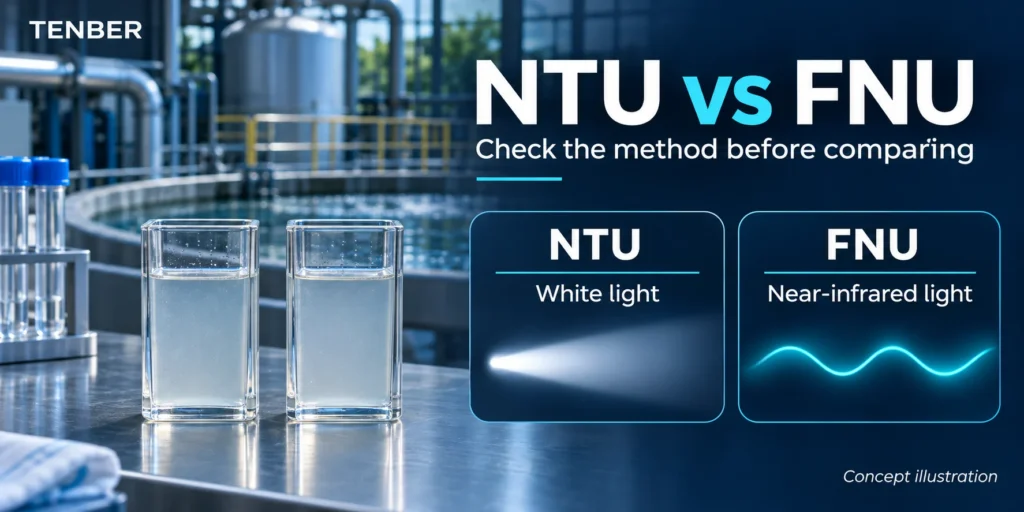
An online sensor reads in NTU. The laboratory report says FNU. Can you compare the two numbers, or change the unit in the PLC and use the same alarm limit?
NTU and FNU both describe turbidity, but they identify different optical measurement methods. NTU commonly refers to white-light nephelometry; FNU refers to near-infrared nephelometry. Both detect light scattered at about 90 degrees. There is no universal NTU-to-FNU conversion factor for real water samples.
Use this NTU vs FNU turbidity guide to check your data. It also helps you define the method before buying a new sensor.
What is the difference between NTU and FNU?
NTU means Nephelometric Turbidity Unit. FNU means Formazin Nephelometric Unit. The key difference is the light source and the associated method, not a fixed change of scale like Celsius to Fahrenheit.
For the common methods compared here, NTU uses white light and FNU uses near-infrared light. The detector measures scattered light at roughly a right angle to the incoming beam. The EPA field turbidity procedure describes this distinction.
| Feature | NTU | FNU |
|---|---|---|
| Full name | Nephelometric Turbidity Unit | Formazin Nephelometric Unit |
| Common light source | White light | Near-infrared light |
| Common method reference | EPA Method 180.1 | ISO 7027-1 nephelometric method |
| Detection angle | About 90 degrees | About 90 degrees |
| Actual water sample | Result depends on optics and particles | Result depends on optics and particles |
| Direct numerical conversion | No universal factor to FNU | No universal factor to NTU |
This table covers the common non-ratio nephelometric comparison. Other optical layouts and reporting units exist. A display marked NTU alone does not establish the wavelength, detector design or method compliance of a complete instrument.
How is turbidity measured with light?
To measure turbidity, an instrument sends a light beam into water. Suspended particles scatter some of that incident light. A detector measures the amount of light that reaches it. In the common methods discussed here, it measures scattered light at 90 degrees. The instrument relates that signal to a calibration standard.
The result helps track water clarity and changes in water quality. It does not identify the particles or prove that water is safe to drink. Drinking water, surface waters and wastewater can contain very different mixes of particles and dissolved colour. That is why the method matters when you compare turbidity readings.
Online sensors and benchtop meters may use different optics. At high turbidity levels, the optical layout and working range also matter. Check the manual instead of assuming all instruments respond in the same way.
How do EPA 180.1 and ISO 7027-1 differ?
EPA Method 180.1 specifies a tungsten lamp with a colour temperature of 2,200–3,000 K. Its stated range is 0–40 NTU. For higher values, the method describes how to dilute the sample. Do not treat that range as the specification of every online NTU sensor.
The FNU method commonly uses near-infrared light around 860 nm. Near-infrared measurement can reduce some effects of dissolved colour, but it does not remove all sample interference.
ISO 7027-1:2016 includes both scattered-light and attenuation methods. An instrument described as “ISO 7027” therefore still needs a clear method and optical specification. Attenuation measures the loss of light through a sample; it is not the same as 90-degree nephelometry.
For a purchase, ask for the current manual and a written statement of the method supported by the supplied sensor. Check the whole measuring system, not just the controller's unit menu.
Can you convert NTU to FNU?
There is no single conversion formula that works for all water. The same particles can scatter white and near-infrared light differently. Particle size, shape and colour can all affect the relationship between the readings.
Why do some references say 1 NTU equals 1 FNU? They are discussing the assigned value of a calibration standard. That does not prove that two different instruments will agree on a river sample or wastewater. USGS reporting guidance makes this distinction between calibration solutions and environmental samples.
If a site needs a relationship between two instruments, collect paired results across its actual operating conditions. Keep the method, range and sample type with the data. Use a site correlation only for the purpose you have checked. It does not change the method or prove that a reporting body accepts it.
Can changing the PLC label convert the reading?
No. Changing a tag from NTU to FNU changes the label, not the light source or detector. Keep the reported unit tied to the documented sensor method. Our turbidity signal scaling guide covers the separate task of matching ranges and signals to a PLC.
Why do an online sensor and a laboratory meter disagree?
Method differences are one possible cause. The two instruments may also be measuring different water. A sample can settle in a bottle, trap bubbles or reach the laboratory after the process has changed.
Check the installation before adjusting the calibration. Fouling on the optical window, an air pocket or a poorly flushed sample line can shift the online result. See the turbidity sensor cleaning checklist for the maintenance side of this check.
Use the following comparison record to separate a method difference from a sampling or setup problem.
| Check | Record for both instruments | Why it matters |
|---|---|---|
| Optical method | Light source, detector layout and method reference | Unit labels alone are incomplete |
| Sample | Point, time and handling | Settling and process changes affect comparison |
| Sensor condition | Cleaning and inspection result | Coatings and bubbles can distort readings |
| Calibration | Standard, date and verification result | A stable display does not prove accuracy |
| Range and output | Display unit, range and PLC scaling | A signal error can resemble a sensor fault |
| Decision | Accepted purpose and any limits | A trend comparison is not method approval |
Repeat the comparison at relevant low, normal and high conditions. Avoid creating an offset from one sample. That offset may hide a fault or fail when the solids in the water change.
Which turbidity unit should you specify for a project?
Start with the required test method and purpose. For process trending, define the sensor method and use it consistently. For a reporting requirement, confirm the accepted method with the project owner or laboratory before ordering.
For projects in Vietnam, Indonesia, Malaysia or the United States, the destination country alone is not enough. Ask the customer for the actual specification, water type, expected range and reference method. A wastewater trend signal and a low-level treated-water check need different selection questions.
The industrial turbidity sensor selection guide covers installation and application fit. This article focuses on units and data comparison.
What should you confirm for a Tenber turbidity system?
The Tenber TUR-6308 turbidity controller page lists NTU as its display unit. Confirm the selected sensor's wavelength, optical method, measuring range and required method documentation before quotation. The display label by itself is not a claim of EPA or ISO compliance.
Send Tenber your turbidity project requirements. Tell us the water type, normal and maximum range, and the method and unit you need. Add the mounting point, fouling load, cable length and PLC connection. If replacing a sensor, share its model and a sample report. This helps us review the full configuration instead of matching only the unit on the screen.
Frequently asked questions
Is FNU more accurate than NTU?
Neither unit is an accuracy grade. Judge the instrument against its method, range, sample conditions and verification results. A method suited to one water type may be a poor fit for another.
Are NTU and FNU the same as total suspended solids (TSS)?
No. Turbidity is an optical measurement. Total suspended solids (TSS) in mg/L describe mass concentration. Any relationship needs sample-specific data; there is no universal factor between them.
Can I keep the same alarm limit after replacing an NTU sensor with an FNU sensor?
Do not assume so. Review the method change, compare results on representative water and confirm the limit's purpose. Obtain the required site approval before returning the new signal to automatic control.