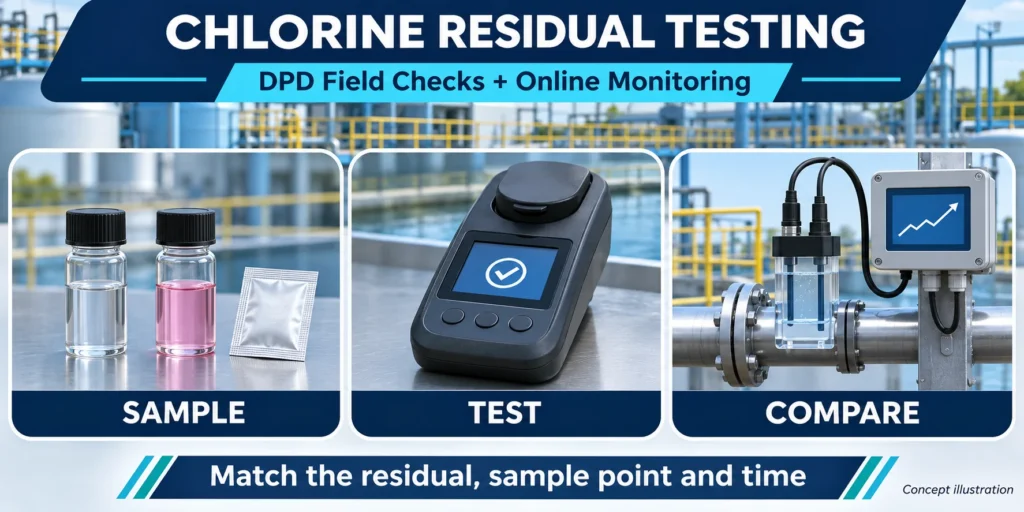
Chlorine residual testing measures the chlorine left in water after treatment and ongoing reactions. Use a suitable DPD field test for a spot check, or an online analyzer for continuous tracking. Specify free or total chlorine before comparing results.
A residual reading helps track treatment. It alone cannot prove water safety or adequate contact time.
How do you test residual chlorine in water?
A common approach is the DPD colorimetric test. The reagent produces a color for a comparator or photometer to read. Choose the method for your residual and range. Free- and total-chlorine tests use different procedures.
For the parameter distinction, see free chlorine versus total chlorine. This guide focuses on collecting, testing and checking a result.
| Method | What it gives you | Main check |
|---|---|---|
| DPD visual comparator | A field reading against a color scale | Correct reagent, lighting and reading time |
| DPD photometer | A measured color response for a defined sample | Clean cell, sample blank, range and method timing |
| Online analyzer | A trend at one monitoring point | Measured residual, sample flow, service and reference checks |
Online analyzers may use colorimetric or electrochemical methods. Check the manual for the measured residual.
A practical DPD chlorine test procedure
Follow your kit instructions for sample volume, reagent dose and reaction time:
- Define the test. Choose free or total chlorine. Check the range, reagent expiry and instrument check status.
- Prepare the sampling point. Follow the site procedure. Record the location, time and operating conditions.
- Collect fresh water. Use the specified clean container and cell. Avoid a bottle with a dechlorinating preservative.
- Prepare the cell. Fill to the mark. Check for fingerprints, bubbles, scratches or condensation. Use the sample blank as directed.
- Add the correct reagent. Mix as instructed. Start the timer. Do not guess the dose or use a total-chlorine reagent for a free-chlorine test.
- Read at the stated time. Log the residual, units and method. Test promptly at the sampling point.
- Review an unexpected result. Check the range, reagents, cell and known interferences. Repeat with fresh water as the method directs.
Health Canada's chlorine technical document explains why you should test chlorine immediately after sampling. Still allow the reagent's stated reaction time.
What can make a chlorine residual test misleading?
| Observation | Possible reason | What to check next |
|---|---|---|
| Lower result after a delay | Chlorine loss or sample reaction | Test a fresh sample at the point of collection |
| Unexpected zero or very low value | No residual, wrong method, expired reagent or an out-of-range response | Check the method range before accepting zero |
| Different readings from repeated tests | Timing, cell condition or changing water | Repeat under controlled conditions and log the times |
| Positive color with another oxidant present | Method interference | Review the method's interference guidance |
Ontario's operator training manual describes DPD interferences, including oxidized manganese and delayed free-chlorine readings in the presence of monochloramine. Check the instructions for other interferences.
A sample blank does not remove every chemical interference. Do not apply an arbitrary correction factor.
Residual chlorine testing in drinking water and wastewater
For drinking water, define the sampling point and required residual. Use the correct test for a chloraminated supply. Follow the project method and monitoring plan.
For wastewater, check for color, solids and other oxidants. Low residuals after dechlorination may need a more sensitive method. Confirm the reporting range and detection capability.
No single alarm limit or testing frequency fits every plant. The process purpose and local requirements determine what is acceptable.
How should a DPD result be checked against an online analyzer?
Compare the same residual in matched water at matched times. Follow the installation instructions to collect a representative grab sample near the analyzer's sample stream. Account for sample-line travel time and any averaging or measurement cycle.
Record the online value for the matched water. Test the grab sample promptly. Repeat while the process is stable, logging the method, units, times and settings.
If the results disagree, check sample flow, bubbles, fouling, reagents and timing before adjusting the analyzer. Review pH effects on free-chlorine sensor readings when the sensor technology makes pH relevant. Set an acceptance criterion suited to the methods and range.
When does continuous chlorine monitoring make sense?
A field test captures one moment. An online system adds trends and can support alarms or a designed control loop. It still needs maintenance and reference checks.
Use our online residual chlorine analyzer selection guide to define the residual, range, sampling conditions and signal needs. Send Tenber your chlorine monitoring requirements. Include the test method, water type and intended alarm or control task.